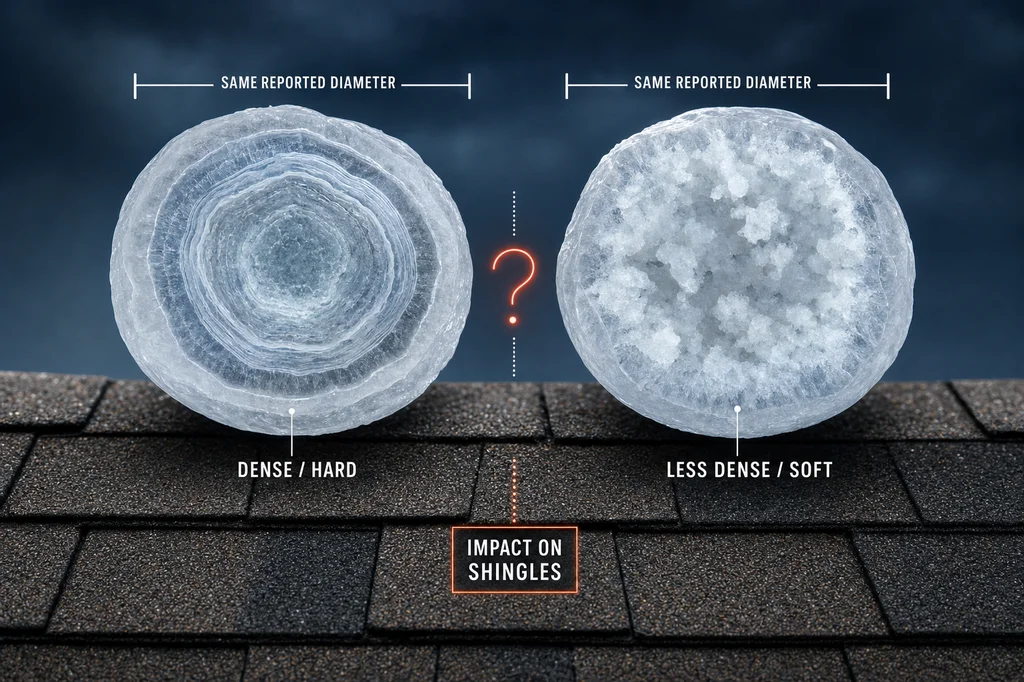
A large-hail report can matter to an asphalt-shingle roof, but it does not by itself establish damage. HailTrace found examples of shingles exposed to baseball-size hail that did not receive damage. One reason may be that hailstones have different internal densities.
That unanswered question is central to HailTrace’s work: whether a storm produced hard hail or soft hail. The company’s long-term goal is to identify areas more likely to have damaging hail, rather than simply showing where hail fell or reporting a stone’s diameter.
Hailstones are built inside a storm
Hail begins with lift: warm air rises into colder air aloft. A front can focus that lift, helping form a thunderstorm. Within the storm, rising air can carry a droplet upward into below-freezing conditions. Supercooled liquid water can also freeze instantly when it contacts something.
The developing stone can cycle through the storm’s rising and falling sections repeatedly. Those trips create the rings visible when a hailstone is cut open. It falls when it becomes too heavy for the storm’s lift to keep it aloft.
That process helps explain why diameter is only one part of the story. Two stones reported at a similar size may not have the same internal makeup. HailTrace is researching whether atmospheric conditions can reveal why particular storms produce harder or softer hail.
Why Colorado and Dallas are frequent hail settings
In Colorado, mountains can provide orographic lift: air moving off the plains is pushed upward by the terrain, supporting thunderstorm development. HailTrace also points to the Palmer Divide south of Denver, where the geography can contribute to shear and storm circulation.
Dallas has broad plains that support storms, and its large footprint makes it less likely for a hailstorm to miss the city altogether. HailTrace also describes an urban heat-island effect: Dallas can be warmer at night than the surrounding air, increasing the warm-to-cold temperature contrast that can strengthen storms moving into the area.
From hail reports to the hard-hail question
Weather information used by the roofing industry has changed over time. HailTrace describes an earlier reliance on NOAA storm reports, followed by maps that outlined where hail fell. Those maps show hail locations; they do not establish that a particular roof was damaged.
HailTrace is not yet offering a homeowner-facing determination that a storm caused roof damage. Its research goal is still developing: analyze atmospheric conditions, distinguish hard from soft hail, and eventually identify locations where damaging hail was more likely.
For now, a report of large hail should not be treated as proof that every asphalt-shingle roof in the area was damaged—or that a roof was unaffected. Reported diameter does not settle the hardness and density question.
Directorii lists verified contractors.
Source: HailTrace: What is Hail? The Science of Hail Explained
FAQ
Does baseball-size hail always damage asphalt shingles?
No. HailTrace describes shingles exposed to baseball-size hail that did not receive damage. Reported size is not a complete indicator because hailstones can have different internal densities.
Why can similarly sized hailstones affect roofs differently?
HailTrace’s research focuses on hard versus soft hail. Hailstones of similar reported diameter may have different internal density and hardness, which can change how they affect asphalt shingles.
How does a hailstone form?
A droplet can be carried upward by a thunderstorm’s lift into freezing conditions. It may cycle through rising and falling parts of the storm, adding layers until it becomes too heavy for the lift and falls.
Why does Colorado get so much hail?
HailTrace attributes part of Colorado’s hail environment to orographic lift from the mountains. It also identifies the Palmer Divide south of Denver as geography that can contribute to storm shear and circulation.
Can a hail map tell whether my roof was damaged?
No. HailTrace describes maps as a way to show where hail fell. Its future research goal is to identify areas more likely to have damaging hail, but that capability remains under development.