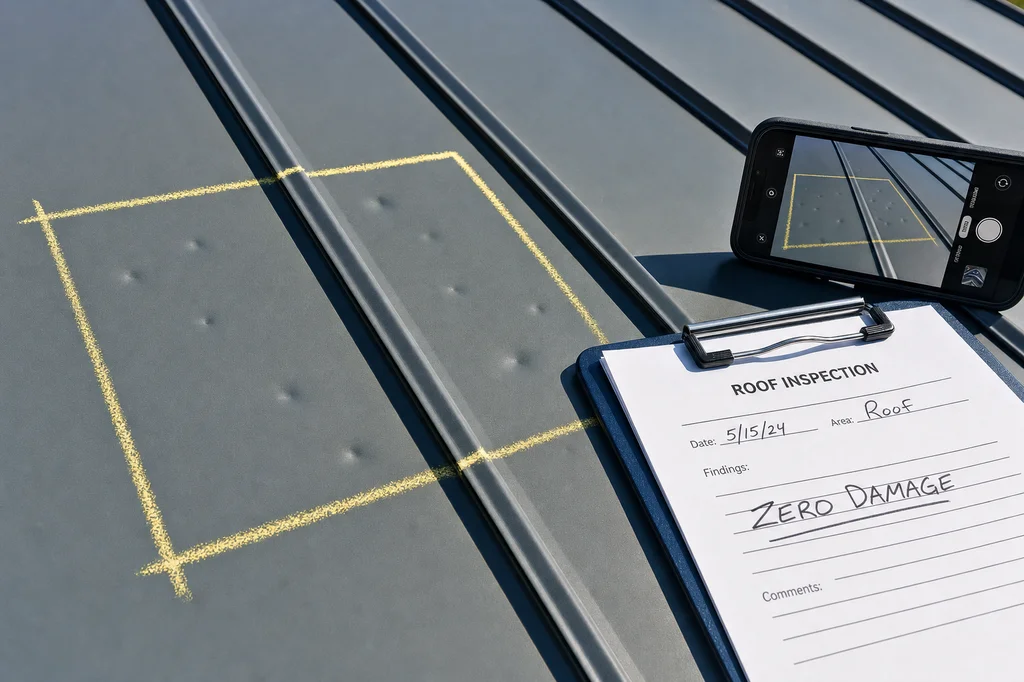
A GuideOne inspection dispute can become difficult when visible metal-roof dents are marked in a test area but the field findings record zero damage. Preserve what was marked, photograph the full context, and request a written explanation before deciding whether to seek a further review.
Why marked metal test areas can matter to your claim
A marked test area creates a useful record of what the adjuster examined at that moment. It does not establish coverage by itself, but it can make a later written finding easier to compare against the conditions observed on the roof.
The reported dispute involved a Minnesota church after a hailstorm described as producing two-inch hail. The roof at issue was a painted standing-seam metal roof, reportedly installed in 2014 and described as either 26- or 28-gauge metal; because that detail was uncertain, it should not be treated as a product specification. The account alleged that the adjuster used yellow chalk to identify dents within two 16-by-16-inch areas, then recorded zero damage for the slope.
That distinction is central for a homeowner. A record that says “zero” may be read differently than one that identifies observed dents but leaves the cause, age, or coverage determination unresolved. Your goal is not to argue a conclusion during the inspection. Your goal is to preserve an accurate record for the insurer’s claim file.
What to document during a GuideOne hail claim inspection
Documenting the inspection can help you retain the details that disappear after chalk washes away or a claim file moves to another reviewer. Focus on the condition, the test area, and the written result—not on trying to diagnose the roof yourself.
- Photograph each marked area from close and wide views. A close image can show the chalk, dent, and surface condition; a wider image helps identify the roof plane and location.
- Record the dimensions and location of the test area. Note the building, slope, and nearby fixed features visible from the ground or from safe access arranged by a roofing professional.
- Capture the notation associated with the area. If an adjuster marks a number, records “zero,” or identifies impacts verbally, write down what was said and when.
- Keep storm-related context separate from conclusions. The account referenced nearby properties with reported hail damage and visible splatter marks. Those facts may be relevant context, but they do not automatically prove coverage for your roof.
- Save all claim communications. Keep estimates, photographs, emails, letters, and claim numbers together so you can compare the field inspection with the insurer’s written position.
Metal damage can be harder to evaluate than a fresh shingle impact. The account described dents on a heavy painted roof as difficult to see, while also alleging that widespread dents and splatter marks were present. That means clear, dated documentation is more useful than a broad statement that the roof “looks damaged.”
Request written findings instead of relying on a verbal answer
If the field inspection appears inconsistent with what was marked, ask for the insurer’s written findings and the basis for the decision. A desk adjuster may review photographs and field notes, so the documents submitted from the inspection can matter as much as the conversation on site.
In the reported church claim, the adjuster allegedly said photographs would be sent to a desk adjuster for review. The later outcome was reported as approval for three of four church buildings, while the first metal-roof building remained unapproved. That is not proof that any particular claim was handled incorrectly. It does show why each building, roof slope, and written determination should be tracked separately rather than assuming one decision applies to the whole property.
Ask the claim representative for:
- The written estimate or denial/partial-denial letter for each roof or building.
- The stated cause of any excluded damage, such as age, prior damage, or a finding that impacts were not storm-related.
- Copies of inspection photographs and field notes that the insurer will rely on.
- Clarification of whether the insurer needs more documentation before completing its review.
Keep the request factual. For example: “Please provide the written findings for the marked test areas on the north slope and explain why the inspection record lists zero damage.” This invites a clear answer without asserting coverage or accusing anyone of misconduct.
Do not assume a dented metal roof has the same outcome as a shingle roof
Hail dents in metal may create a different claim question than shingle impacts. The reported account argued that low spots could eventually rust, while also acknowledging that the roof might not leak immediately. Whether a policy covers cosmetic damage, functional damage, rust-related concerns, or replacement depends on the policy language and the facts of the loss.
For homeowners, the practical issue is to distinguish three things:
- What is visible: dents, chipped coating, splatter marks, distorted panels, or other documented conditions.
- What a roofing professional finds: whether the observed condition affects the roof system and what repair or replacement work is recommended.
- What the insurer determines: whether the policy covers that condition and, if so, what payment or scope is approved.
Do not climb onto a roof to collect evidence. Have a roofing professional document the metal panels, seams, coating, flashings, and related components from appropriate access. If the claim turns on a technical question, an engineer can provide an opinion within their field. Insurance coverage questions should go back to the insurer, and legal questions should go to qualified counsel or your state insurance department.
When an inspection record and a roof report do not match
A difference between an insurer’s findings and a roofing assessment is a reason to organize evidence, not a reason to assume either side is right. Obtain a detailed roof report that identifies the affected building and roof areas, then compare it with the insurer’s estimate or written decision.
Choose a roofing professional who can provide a clear, property-specific scope and explain what is observed without promising a claim result. Directorii lists verified contractors.
Recording an adjuster requires care
Recording rules vary by state and by the circumstances of the conversation. The account said the inspection occurred in Minnesota and asserted that one-party consent applied there, but homeowners should not rely on a general statement about recording laws.
Before recording an adjuster, confirm current state requirements with qualified counsel or your state insurance department. You can still create a useful contemporaneous record without recording: take permitted photos, write down names and times, preserve letters, and send a short email summarizing what you understood from the inspection.
Source: GuideOne hail-claim inspection account
FAQ
What should I photograph during a GuideOne hail claim inspection?
Photograph any marked test area from both close and wider views, along with the roof plane, building location, and any notation tied to the area. Preserve dates, claim communications, and the adjuster’s written findings. Do not climb onto the roof yourself; arrange appropriate access through a roofing professional.
What if an adjuster marks metal-roof dents but records zero damage?
Request the insurer’s written findings and ask for an explanation of how the marked test area was evaluated. Keep photos of the markings and ask for the inspection photographs and field notes used in the claim review. A zero notation alone does not determine coverage, but it is worth clarifying promptly.
Can hail dents in a metal roof be denied as old damage?
An insurer may evaluate whether visible dents are related to the reported storm, prior damage, wear, or another cause. Document current conditions, storm context, and the specific roof area at issue. Coverage depends on the policy and claim facts, so request the insurer’s written basis for any exclusion or denial.
Should I get a roofer’s report before asking for a claim review?
A detailed report can help identify the building, roof slopes, visible conditions, and recommended work to compare with the insurer’s written findings. The report should not promise coverage or replace the insurer’s decision. Use a roofing professional for roof access and technical observations, especially on standing-seam metal.