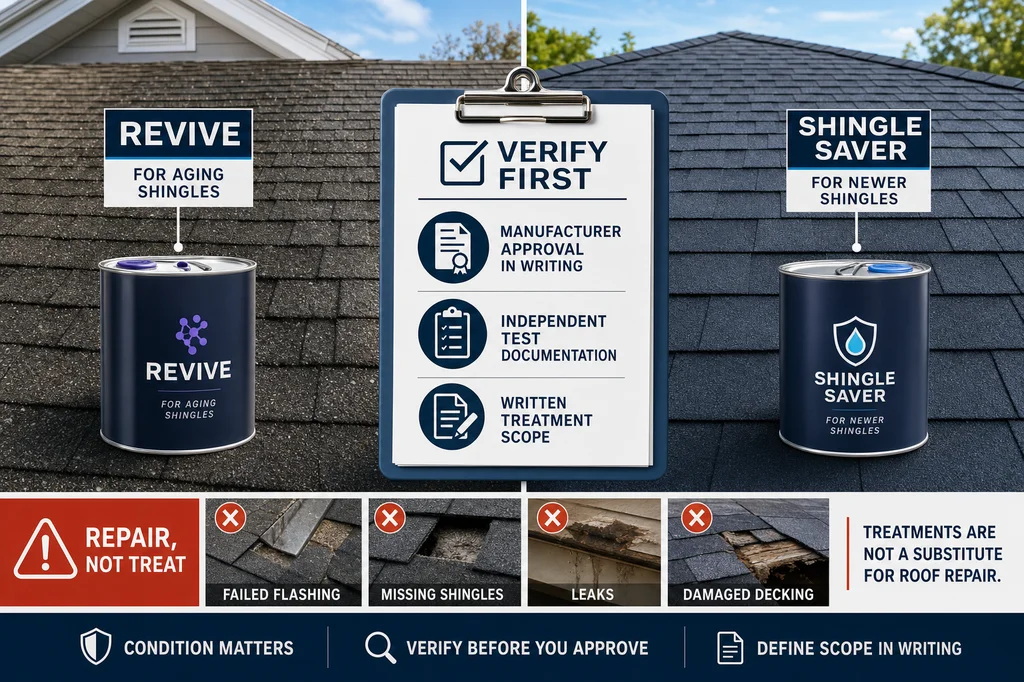
A GoNano Revive-versus-Shingle Saver review starts with their intended uses: GoNano markets Revive for aging asphalt shingles and Shingle Saver for newer shingles. Before approving either one, separate GoNano’s performance claims from independently documented results, check your shingle manufacturer’s position, and get a written plan for what happens if the treatment does not perform as expected.
How GoNano separates Revive from Shingle Saver
GoNano presents Revive as its treatment for aging asphalt shingles and Shingle Saver as a preventive treatment for newer shingles. The dividing line matters because a roof with advanced wear may need repair or replacement rather than a surface treatment.
GoNano’s CEO said Revive is intended for shingles roughly 10 to 20 or 25 years old, while Shingle Saver is intended for shingles under 10 years old. He also described Shingle Saver as suitable for a brand-new roof. Both products are said to use bio oil along with nano-scale components intended to address oxidation and help retain oil in the shingle.
That is the company’s product positioning, not a diagnosis of your roof. A treatment may be worth evaluating when shingles are aging but the roof is otherwise a candidate for continued service. It is a poor substitute for correcting active leaks, failed flashing, damaged decking, missing shingles, or other defects that require roofing work.
- Consider Revive only after a roof assessment: Older shingles can have conditions that a treatment cannot correct.
- Consider Shingle Saver as a preventive option: Its stated role is to protect newer shingles before substantial aging occurs.
- Do not choose by roof age alone: Shingle condition, prior repairs, ventilation, and water entry points still affect whether treatment makes sense.
What GoNano claims its roof treatments can do
GoNano markets its treatments as more than a temporary oil application. The company says its formulation bonds within the shingle, helps limit oxidation, sheds water, and improves resistance to wind and impact.
GoNano’s CEO said the company’s testing showed treatments could increase impact and wind resistance and could make an older shingle more impact-resistant than a new three-tab or architectural shingle. He also described a potential service-life increase from a single treatment and discussed the possibility of repeated treatments over time.
For a homeowner, the practical meaning is simple: do not treat those statements as a replacement warranty, an insurance benefit, or proof that an existing roof is structurally sound. A treatment that improves some material characteristics may still leave roof-system problems untouched. Penetrations, flashings, fasteners, valleys, edges, ventilation, and concealed moisture are separate concerns.
GoNano also compared its products with soy-based rejuvenation products, characterizing those alternatives as more temporary. That is GoNano’s comparison and should not be treated as a verified performance finding about every competing product.
Independent testing matters more than a live demonstration
GoNano says it has invested heavily in data, worked with Canadian research centers and IBHS, and referred to ASTM standards and UL 2218. The company also says it developed its own GoNano test after finding that outside tests did not answer all of its questions.
A demonstration can show that a treated sample behaves differently under one set of conditions. It cannot, by itself, establish how your installed roof will perform through weather exposure, roof movement, repairs, and the particular failure modes of your shingle type.
Request the actual documents before agreeing to treatment. Useful records identify the precise product, shingle type, sample age, test method, laboratory, test date, and measured result. Be cautious if the only evidence is a sales presentation, a social-media clip, or a result from a company-created test without enough detail for you to evaluate it.
Will a GoNano treatment affect your shingle warranty?
A roof treatment can affect warranty questions, so manufacturer approval is a central decision point. GoNano’s statements about protection or rejuvenation do not establish that the maker of your shingles accepts the application.
Contact the shingle manufacturer with the full product name—GoNano Revive or GoNano Shingle Saver—and ask whether applying it to your specific shingles affects any existing warranty. Provide the manufacturer with the product data sheet and proposed application details if requested. Get the response in writing and keep it with your roofing records.
This check is especially important on a newer roof. GoNano argues that earlier treatment is better, but a homeowner should weigh that claimed preventive value against any possible change to manufacturer support. If a roof is already near the end of its useful condition, ask whether replacement is the more sensible path instead of paying to treat material that may soon need removal.
Put the installer’s responsibility in writing
The installer’s scope should explain exactly what the treatment includes and what it does not fix. This protects you from treating a product application as though it were a complete roof repair.
Your written agreement should identify the GoNano product, the roof areas to be treated, the pre-existing conditions documented before application, and any repairs required first. It should also state who is responsible if overspray, staining, drainage issues, or alleged treatment failure occurs. If the provider promises a performance period or maintenance schedule, have those terms written plainly rather than relying on a verbal assurance.
Questions to settle before treatment day
- Which product is proposed, and why is it appropriate for my shingles’ condition?
- What independent test reports support the specific performance claims being made?
- Has my shingle manufacturer approved this application in writing?
- What roof defects must be repaired before the product is applied?
- What result is the installer promising, and what written remedy applies if that result is not achieved?
- Will the agreement distinguish treatment work from leak repair, flashing repair, and replacement work?
A qualified roofing professional can assess whether your roof is a treatment candidate before any product is applied. Directorii lists verified contractors.
Do not assume an insurer will treat the roof as new
GoNano’s CEO described conversations with insurers and reported examples where treated roofs appeared improved during later inspection. Those reports are not proof that an insurer will accept a treatment as a repair, extend coverage, reduce a deductible, or change a replacement decision.
Insurance treatment depends on your policy and the insurer’s evaluation of the loss. If you are considering GoNano after storm damage or during an insurance dispute, obtain the insurer’s position in writing before presenting the treatment as part of a claim solution.
Source: Jonathan Duquette on GoNano roof technology
FAQ
What is the difference between GoNano Revive and Shingle Saver?
GoNano presents Revive for older shingles and Shingle Saver for shingles under 10 years old, including newer roofs. That distinction is the company’s product positioning, not proof that every roof in those age groups should be treated. Have a roofing professional evaluate leaks, flashing, missing shingles, and other defects before choosing either treatment.
Can GoNano make an old asphalt-shingle roof perform like a new one?
GoNano claims its treatment can improve impact and wind resistance, including on aging shingles, but that claim should be verified through applicable test documentation. A treatment does not automatically correct roof-system defects such as failed flashing, damaged decking, or active leaks. Review the evidence for your shingle type and roof condition.
Should I apply GoNano Shingle Saver to a brand-new roof?
GoNano says Shingle Saver can be used on a brand-new roof as preventive protection, but you should first obtain your shingle manufacturer’s written position. A newer roof may still have a manufacturer warranty that could be affected by an added treatment. Compare the claimed benefit with any warranty implications before authorizing the work.
How can I verify GoNano roof-treatment testing?
Ask for reports that identify the exact product, shingle type, sample age, laboratory, test method, date, and results. GoNano says it has worked with outside organizations and also developed its own test, so distinguish third-party reports from company-created testing. A live product demonstration is not a substitute for complete documentation.
Will my insurer accept a GoNano-treated roof as repaired?
You should not assume an insurer will treat a GoNano application as a repair or as evidence that a roof is like new. GoNano’s CEO reported insurer interest and favorable inspection examples, but coverage decisions depend on the policy and insurer evaluation. Ask your insurer for its position in writing before relying on treatment in a claim.