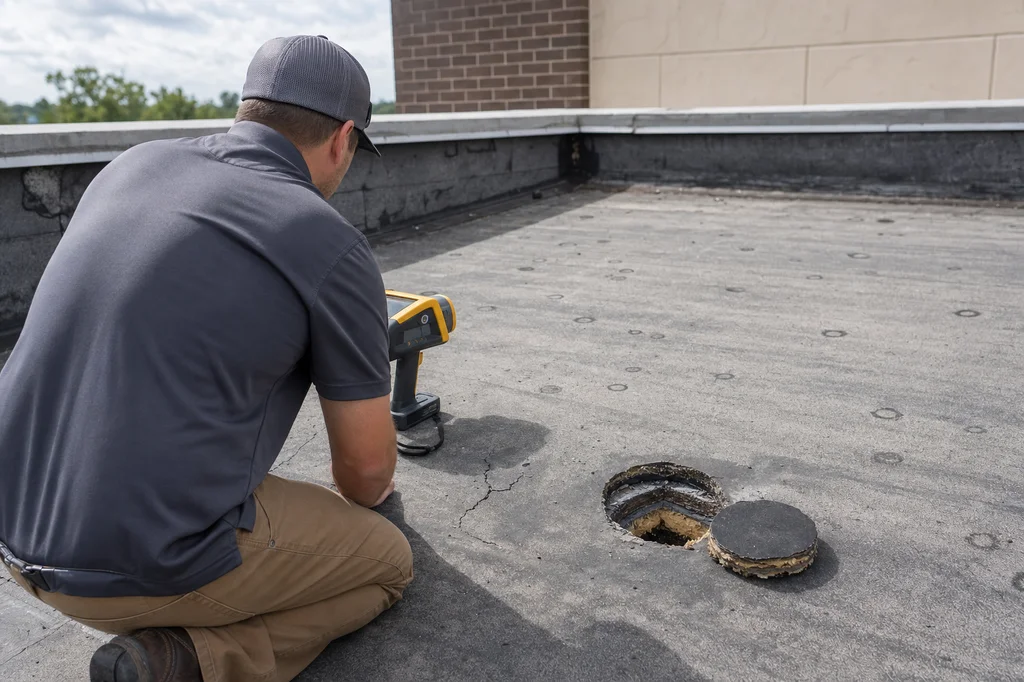
A disputed roof claim is not resolved by a close-up photograph alone. Forensic Building Science describes its work as telling the story of the building: considering the possible causes of a condition, eliminating causes that do not fit, and reaching a causation conclusion from the available evidence.
For an alleged hail loss, that story may need to connect the claimed date of loss, the roof's maintenance history, visible conditions, moisture findings, material fractures, and testing. If those pieces do not align, a hail conclusion may be difficult to support.
Start with the cause, not a preferred outcome
A causation investigation can consider whether a roof condition is consistent with a claimed storm event, maintenance issues, a construction defect, or another explanation. The task is not to make the damage fit an initial theory. It is to evaluate the building evidence and rule potential causes in or out.
Forensic Building Science says it does not adjust claims or provide legal opinions. Its work concerns causation: what happened to the building and what the evidence supports. The same process can lead to a finding that there is no damage, that the claimed event was not the cause, or that a different cause is more likely.
What a flat-roof hail investigation can examine
On a flat or low-slope roof, an investigator may look beyond surface marks. Questions can include whether moisture is present in the roof substrate and whether the roofing material has actual fractures or cracks.
Infrared scanning may be used to look for moisture. Roof core samples can provide additional information about the roof assembly. Together with an on-site evaluation, these tools can help distinguish a possible hail impact from conditions that may instead relate to maintenance or another cause.
Maintenance records are part of that assessment. If records show maintenance issues and the observed condition does not look like a hail impact, those facts may point away from a hail explanation. A mark or crack considered by itself is not necessarily the full answer.
Why the claimed date of loss matters
Timing is part of the evidence chain. A claimed event may be easier to evaluate when the physical findings and property history line up with it. For example, a hail event, a roof condition consistent with impact, and reports of leaks immediately afterward can form a more coherent building story than any one fact alone.
Multiple later hail events can make the analysis harder. When several events have occurred after the claimed date of loss, an investigator may need to separate damage associated with each event. Forensic Building Science also describes using meteorological information when a date-of-loss question needs investigation.
When an independent causation opinion may help
An independent opinion may be useful when the central disagreement is about cause rather than a straightforward repair scope: hail versus maintenance, uncertainty about moisture below the surface, questions about fractures, or competing explanations for the roof condition.
Not every claim needs this level of investigation. Forensic Building Science says it reviews cases before taking them and does not take every case presented. An opinion is not a promise of replacement or payment; it may conclude that the evidence does not support the theory presented.
Set the investigation around the actual evidence question
Before authorizing an investigation, define the causation question and the claimed date of loss. The scope can then address the evidence that may matter to that question rather than assuming the answer in advance.
- Which possible causes will be evaluated?
- What maintenance records relate to the roof condition?
- Is moisture evaluation needed, including infrared scanning?
- Are roof core samples needed to examine the assembly?
- Are there actual fractures or cracks in the roofing material?
- Does the work address causation only, or is estimating handled separately?
A roofing contractor can document observed conditions and prepare a repair or replacement scope. A causation expert addresses what the building evidence supports. Once the needed work is clearer, compare the written roofing scope with the physical findings rather than assuming every claimed item belongs in the work. Directorii lists verified contractors.
A consistent story is stronger than a single clue
A plausible hail conclusion should align the physical findings with the building's maintenance history, documented timing, and any moisture or fracture testing. Infrared scans and core samples may add useful information, but their value is in how they fit the complete evidence chain.
A causation report can make a disagreement more specific, but it does not determine insurance coverage or provide legal advice. For coverage or legal questions, consult the insurer, the state insurance department, or a licensed professional.
Source: Forensic Building Science interview
FAQ
What is forensic building science in a roof claim?
Forensic Building Science describes causation work as evaluating what happened to a building by considering and eliminating potential causes. In a roof claim, the work may assess whether the evidence fits a claimed storm event, maintenance issues, a construction defect, or another cause. It does not adjust claims or provide legal opinions.
What evidence can help evaluate alleged hail damage on a flat roof?
Relevant evidence may include the claimed date of loss, maintenance records, moisture in the roof substrate, actual fractures or cracks in the roofing material, infrared scanning, and roof core samples. The point is to see whether these findings tell a consistent story.
Why can later hail events complicate a roof claim?
Several hail events after the claimed date of loss can make it harder to separate damage associated with one event from damage associated with another. A causation investigation may need to evaluate timing along with the physical roof evidence.
Can infrared scanning prove that hail caused roof damage?
Infrared scanning may be used to look for moisture, but it is one part of an investigation. A causation conclusion may also depend on substrate moisture, material fractures, maintenance history, roof core samples, and the timing of the claimed event.
Does a forensic causation report guarantee roof replacement or claim payment?
No. A causation report addresses what the building evidence supports. It may find that the claimed damage is not present or that another cause is more likely, and it does not determine insurance coverage or guarantee payment.