Operation Bad Builder, a Hillsborough County undercover operation that led to 50 arrests, is a reminder to verify a Florida contractor before you pay a deposit. An appealing online ad, immediate availability, or a low quote does not establish that a company has the active license, insurance, and permit responsibility your project may require.
What Operation Bad Builder found in Hillsborough County
Detectives posed as homeowners, responded to online construction advertisements, and invited suspected unlicensed workers to provide estimates. The operation ran from June 1 through October 2, 2026, with results announced on October 22.
Some people contacted during the operation were found through ordinary online searches. Others had already drawn complaints alleging poor work, unfinished work, or money taken without completion. That distinction matters: an online listing can help you find a contractor, but it is not a background check.
The arrests are allegations, not convictions, and the operation does not establish that every person arrested stole from a homeowner. Still, the investigation highlights a costly hiring failure: accepting a sales pitch before checking whether the person or company is qualified to do the work offered.
Run a Florida license check before accepting the estimate
Check the license yourself before any payment changes hands. In Florida, the building-trades representative at the press conference directed homeowners to MyFlorida.com to verify whether a contractor has a current license.
Match the result to the actual work on your home. A business name, a person’s name, and the type of work offered should line up with the active license record. Roofing, electrical, plumbing, HVAC, concrete, and foundation work can create problems that are not visible once the job is covered or a wall is closed.
A license is not a promise of perfect work. It is one threshold check. The practical benefit is that you can pause an estimate that does not match an active credential instead of discovering that mismatch after a payment.
If you are unsure what credential your project calls for, contact the licensing office rather than relying on a salesperson’s answer. Local requirements can vary, and the licensing office can help clarify the work involved.
Do not let speed, savings, or permits become the pressure point
The pitch described in the operation had a recognizable pattern: start immediately, skip permits and inspections, and save the homeowner substantial money. Those promises can feel especially compelling after storm damage, when a household may be trying to get back into a usable home.
Speed is useful only when the company can perform the job properly and complete it. A low bid is not proof of fraud, just as a high bid is not proof of quality. What deserves scrutiny is pressure to commit before you can verify the company or compare what the bids actually include.
- “We can start tomorrow.” Treat availability as one bid detail, not proof that the contractor is qualified.
- “You do not need a permit.” Check with your local building department. Permit requirements depend on the work and location.
- “It will cost far less.” Compare materials, scope, cleanup, inspections, and payment terms—not only the total quoted price.
- “Pay now so we can hold your spot.” Finish the credential and contract checks before sending money.
Get insurance, permits, scope, and payments on paper
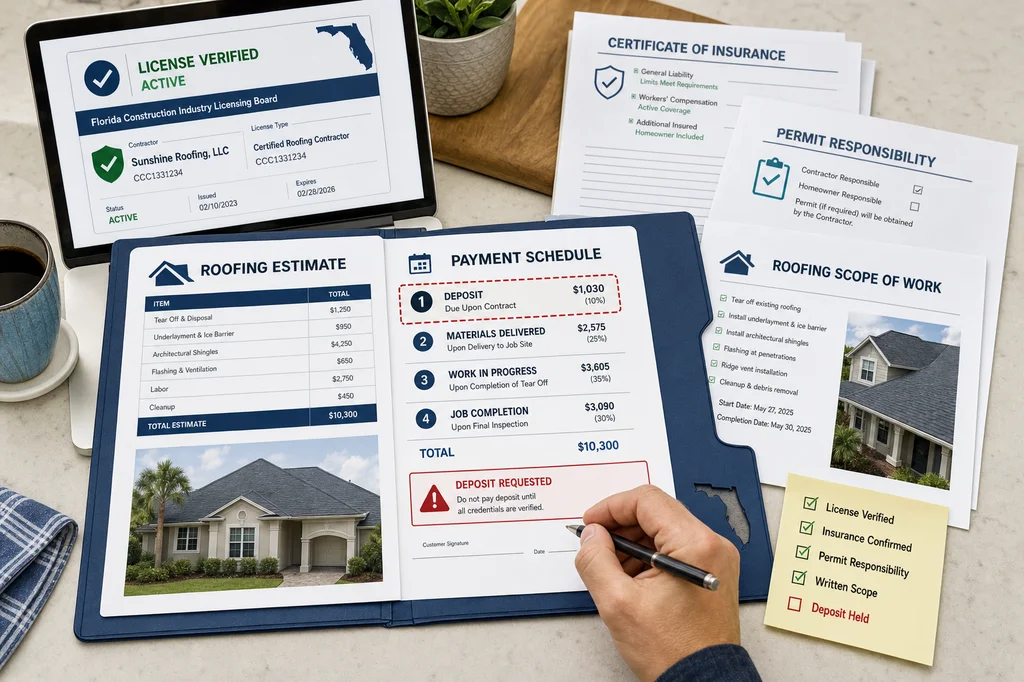
A license record alone does not tell you what you are buying. Your agreement should make the work and the money trail understandable before the project starts.
- Request proof of insurance. Confirm coverage with the insurance agent, rather than treating a document handed over during a sales visit as final verification. Check workers’ compensation coverage or a valid exemption where applicable.
- Set permit responsibility. Confirm permit requirements with the building department and state in the contract who will obtain any required permits. Do not assume that responsibility belongs to the contractor or homeowner without seeing it written down.
- Define the scope. The written scope should identify materials, the expected start date, expected completion, cleanup, and the work being performed.
- Break out the payment schedule. You should be able to see what each payment covers. Keep the signed agreement, receipts, messages, and project photographs together.
The concern is not every request for a deposit. Legitimate contractors may need funds for materials. The risk rises when a large upfront request is paired with an unverified license, vague work description, or a demand to decide immediately.
Use references to test how the company finishes work
Finished-project photos show appearance, but they do not tell you how the company communicated, handled a problem, or completed the promised scope. Recent references can fill in those gaps.
Ask references whether the work was completed, whether the company communicated clearly, and how it responded when an issue came up. Keep the questions focused on the type of project you are considering. A contractor who provides a clear license record, insurance information, written scope, and workable payment schedule gives you more to evaluate than a persuasive kitchen-table pitch.
If you are overwhelmed by storm repairs or several estimates, have someone you trust help review the documents before you commit. Directorii lists verified contractors.
What to save if a contractor dispute develops
Keep your contract, estimates, invoices, payment records, messages, photographs, and permit records in one place. Those records help establish what was promised, what was paid, and what work was completed.
If you believe you were victimized in Hillsborough County, the sheriff’s office asked homeowners to contact its detectives. For questions about a license, permit, or insurance coverage, use the appropriate licensing office, building department, or insurance agent rather than assuming the answer from a contractor’s sales presentation.
Source: Operation Bad Builder coverage
FAQ
How do I check whether a Florida contractor has an active license?
Check the contractor through MyFlorida.com before making a payment, then compare the record with the business or person offering the work. Make sure the license is current and fits the type of work proposed. If the required credential is unclear, contact the licensing office for guidance.
What did Operation Bad Builder show homeowners to watch for?
Operation Bad Builder showed that unlicensed workers can be found through ordinary online advertisements as well as through complaint-driven investigations. The key warning signs were pressure to start immediately, promises to avoid permits or inspections, unusually low pricing, and requests for money before basic credentials were verified.
Should I pay a contractor a deposit before work starts?
A deposit alone does not prove a contractor is dishonest, because a legitimate company may need money for materials. Before paying, verify the active license and insurance, obtain a written scope, and understand exactly what the payment covers. Avoid paying the entire job amount upfront.
Can a contractor tell me that my Florida project does not need a permit?
A contractor can offer an opinion, but you should confirm permit requirements with your local building department. Requirements depend on the location and the work being done. Your written agreement should also identify who is responsible for obtaining any permits that are required.
What should be included in a contractor payment schedule?
A useful payment schedule identifies what each payment covers and connects payments to understandable parts of the work. Pair it with a written scope covering materials, expected start and completion dates, cleanup, and the work to be performed. Keep copies of receipts, messages, and the signed contract.
What records should I keep if a contractor leaves work unfinished?
Keep the contract, estimates, invoices, payment records, messages, photographs, and permit documents together. These materials help show the agreed scope, payments made, and project condition. For a license, insurance, or permit question, contact the appropriate agency or insurance agent.