A 130-mph wind warranty can sound decisive when choosing a Florida roof. Hurricane Ian offered a more complicated lesson: newer construction often performed better, but a surviving house cannot be explained by a roof label alone.
The Fort Myers Beach image that showed newer construction
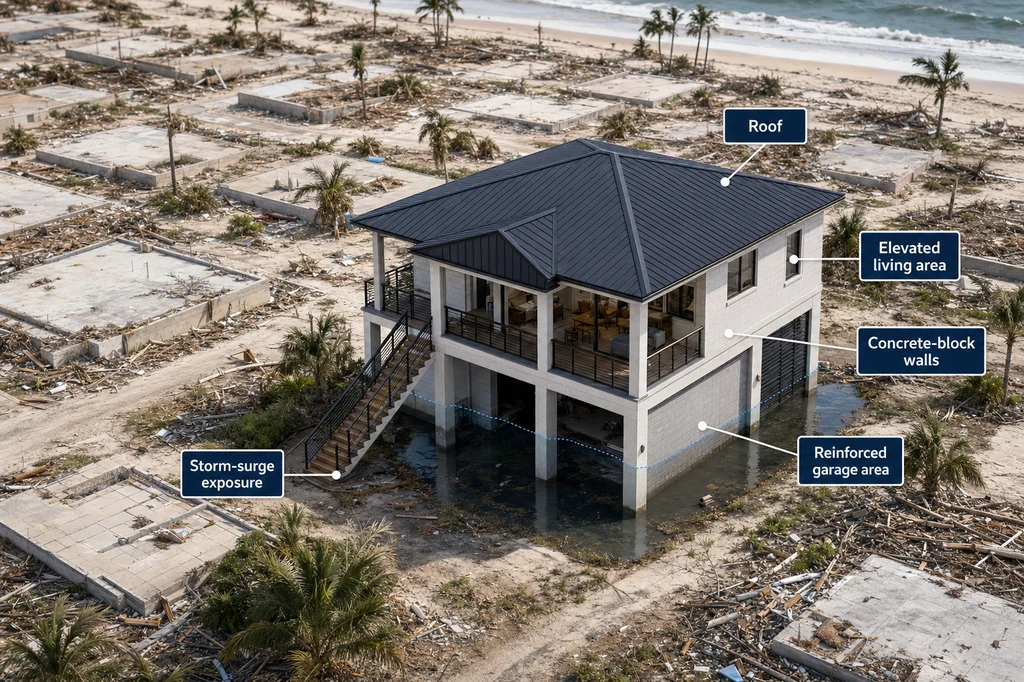
A preliminary report to the Florida Building Commission included an aerial photograph of Fort Myers Beach showing 18 homes built before 1981 that were wiped away. A house built in 2020 appeared largely intact.
That newer home was elevated above much of the storm-surge level. Storm surge punched through its elevated first floor, while its walls appeared to be concrete block with reinforced concrete around the garage-door area. The roof appeared undamaged, but the home’s elevation and wall construction mean its outcome cannot be credited to roofing alone.
An Applied Research Associates wind map reported peak gusts of 100 mph at Fort Myers Beach and up to 120 mph on part of nearby Sanibel Island. CoreLogic reported that wind losses in Lee County were twice as high for structures built before 1996, when Florida began statewide building codes for wind loads.
Why a 130-mph claim did not settle the question
Most asphalt shingle products carry 130-mph wind warranties. Yet winds in the Fort Myers Beach and Sanibel Island areas were roughly 100 to 120 mph, and roof outcomes still varied sharply.
Florida code can allow lower-cost asphalt shingles to pass. Code compliance is an important threshold, but it does not prove that two roofs with similar paper ratings will have the same outcome after a hurricane.
A warranty or advertisement is one piece of product information. Hurricane and hail damage can show how roofs performed after an event, although the result at one home can reflect more than the roof material.
What remained after the storm
Many of the roofs still standing in hurricane-damage images were metal roofs, with some rubber shingles also visible. That observation does not guarantee that metal or rubber shingles will outperform every asphalt roof on every house.
The 2020 Fort Myers Beach home illustrates why roof material is only part of the picture. Elevation, concrete-block construction, reinforced concrete near the garage doors, storm-surge exposure, and other building characteristics all matter.
When comparing roofing options, look beyond whether a product meets Florida code or carries a high wind rating. Consider the roof system, the building conditions, and performance after strong wind or hail events.
The repair question for older Florida roofs
Older roofs can raise a separate issue after damage. Florida lawmakers approved Senate Bill 4G, changing building-code treatment for certain repairs when less than 25 percent of a surface area is damaged in most cases.
An unresolved question is whether a repaired roof section must meet the current building code or may be repaired to the code in effect when most of the roof was installed. This can matter for homes built in the 1980s or 1990s. Confirm current requirements with a licensed professional or appropriate state authority.
Use Ian’s lessons without reducing them to one number
Ian supported the conclusion that newer Florida construction and newer wind-focused codes made a meaningful difference. It did not prove that a 130-mph warranty predicts hurricane survival or that one roof material alone determined which homes remained standing.
The Fort Myers Beach home is a reason to examine how a house was built: its roof, materials, code era, elevation, and construction details all contributed to its condition after the storm.
Directorii lists verified contractors.
Source: They Don't Build Roofs like They Used To... New Study Shows the Opposite
FAQ
What did Hurricane Ian show about newer Florida homes?
A Fort Myers Beach image in a preliminary report to the Florida Building Commission showed 18 homes built before 1981 wiped away while a 2020 home appeared largely intact. CoreLogic also reported that wind losses in Lee County were twice as high for structures built before 1996.
Does a 130-mph roofing warranty mean a roof will survive hurricane winds?
Not necessarily. Most asphalt shingles carry 130-mph wind warranties, but roof outcomes varied after winds of about 100 to 120 mph near Fort Myers Beach and Sanibel Island. A warranty does not account for every part of a home or roof system.
Did the 2020 Fort Myers Beach home survive because of its roof?
Its roof appeared undamaged, but the house was also elevated above much of the storm surge and appeared to have concrete-block walls with reinforced concrete around the garage-door area. Storm surge punched through the elevated first floor, so its condition cannot be attributed to roofing alone.
Were metal roofs the only roofs left standing after Ian?
No. Many roofs still standing in hurricane-damage images were metal roofs, and some rubber shingles were also visible. Those observations do not guarantee that a material will perform the same way on every home or in every storm.
What repair issue did Senate Bill 4G raise for older Florida roofs?
Senate Bill 4G changed building-code treatment for certain repairs when less than 25 percent of a surface area is damaged in most cases. The unresolved question is whether a repaired section must meet the current code or may be repaired to the code in effect when most of the roof was installed.