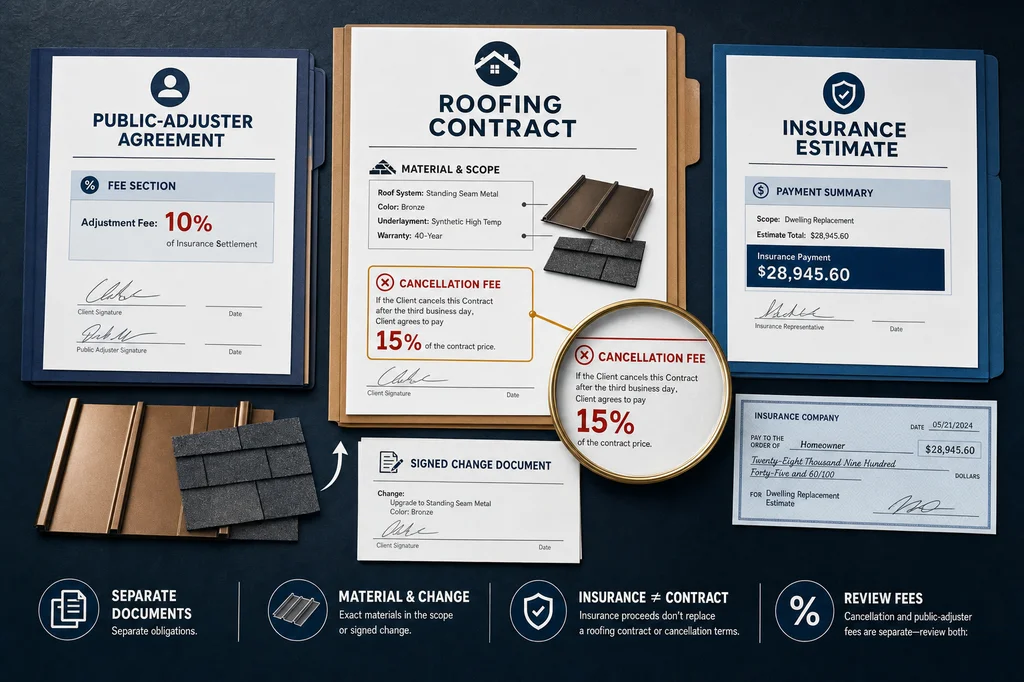
An Evolve Construction cancellation-fee dispute described by an Illinois homeowner is a warning about bundled storm-repair paperwork. Before paying an insurance advance or accepting a contractor-referred public adjuster, make sure your roof material, payment handling, cancellation terms, and adjuster fees appear in separate signed documents.
Why separate documents matter after storm damage
A roofing contract and a public-adjuster agreement can create separate obligations, even when the same person presents both forms at the kitchen table. You should be able to identify exactly what each document authorizes, who is paid, and what happens if the roofing work does not move forward.
In the reported case, the homeowner said an Evolve representative encouraged the household to hire a public adjuster the same day they signed with Evolve. The homeowner later said notes about wanting a metal roof were written on the public-adjuster paperwork, rather than clearly incorporated into the roofing contract.
That distinction matters. A note on one agreement may not establish the scope of another agreement. If you want metal roofing rather than shingles, upgraded gutters, chimney work, or another change, the construction agreement should state it plainly. It should also say whether insurance proceeds, your deductible, or your own funds are expected to pay for each part of the work.
- Roofing contract: Identify the exact roof material, the work included, the payment schedule, and cancellation language.
- Public-adjuster agreement: Identify the adjuster, the fee basis, the services authorized, and how ending that agreement is handled.
- Insurance estimate: Treat it as the insurer's scope and payment document, not as a substitute for your construction contract.
- Written changes: Put substitutions, upgrades, and price differences into a dated, signed change document before work is scheduled.
How an Evolve Construction cancellation-fee dispute can develop
The reported dispute did not start with a homeowner refusing completed work. It developed after missed insurer meetings, uncertainty about the selected roof material, and long periods without a clear response, according to the homeowner interviewed.
The homeowner said an Evolve employee missed two appointments with the insurance adjuster. Later, the homeowner received an email indicating that shingles ordered for the job were unavailable and would be substituted. That prompted the homeowner to object because the household had intended to install a metal roof and pay the difference themselves.
The homeowner also reported sending an insurance payment to Evolve before work began. After attempts to contact the company and a lawyer's demand letter, the homeowner said a caller claimed the household was in breach and would face a 35% cancellation fee, along with responsibility for public-adjuster charges.
The meaning for you is straightforward: an insurance check does not eliminate the need for a defined scope, a reachable company contact, and documented next steps. Before transferring an advance, know what event triggers payment, where funds are going, and what happens if the stated material or scope changes.
Terms that deserve a slow read before you sign
A cancellation clause can be costly because it may be calculated from the contract amount rather than the contractor's actual completed work. Read the clause before signing, not after a dispute begins.
In this account, the homeowner described a 35% cancellation demand. The homeowner also described a public-adjuster agreement that could charge 15% of the adjuster's appraised value if the agreement was not fulfilled. Those reported terms are not universal, and your documents may be different. Still, they show why you should calculate the effect of every separate agreement before accepting a bundled sales presentation.
Pay special attention to language covering cancellation, breach, liquidated damages, collection costs, dispute resolution, public comments, and liens. Contract enforceability and lien rules vary by contract and state. If you do not understand a clause or are being pressed to sign immediately, pause and have a qualified attorney review it.
What to say when a contractor refers a public adjuster
A referral is not a reason to sign both agreements at once. You can separate the decisions and evaluate whether the public adjuster's fee and role make sense for your claim.
Use direct questions that produce documents rather than sales assurances:
- “Is hiring this public adjuster required to use your roofing company?”
- “What is the public adjuster's fee, and what number is it calculated from?”
- “Will the adjuster agreement remain in effect if I choose another roofer?”
- “Please show the exact roof material, color, and system that will be installed.”
- “If the specified material is unavailable, may you substitute it without my signed approval?”
- “What payment do you expect from the first insurance check, and what work or materials does that payment cover?”
Keep copies of every version of the estimate, contract, email, text, payment record, and insurer correspondence. If a company later claims your selection was shingles when you expected metal, the signed scope and approved changes are more useful than a verbal recollection.
When missed appointments and silence become a project risk
One scheduling error can happen. Repeated missed appointments, unanswered written communications, and unclear material substitutions can leave your insurance claim and repair plan out of sync.
In the reported case, the homeowner said the insurer had approved roof replacement, chimney repair, and fence replacement, yet work had not started after months of communication problems. The homeowner then faced uncertainty over cancellation and repayment while still needing the repairs completed.
Do not treat a contractor's involvement in an insurance meeting as automatic proof that the company is managing the claim. Keep track of insurer deadlines and communications yourself. If you need help interpreting coverage or handling a claim dispute, contact your insurer, state insurance department, or a qualified insurance professional. A roofer is not the final authority on coverage.
Choosing the wrong company can make a storm claim harder to close and can tie up funds needed for repairs. Directorii lists verified contractors.
How to respond to a cancellation demand or threatened lien
Do not ignore a written demand, but do not assume the sender's conclusion is correct either. Preserve the record, communicate carefully, and get advice suited to your contract and state.
In the account, the homeowner said attempts to send a demand letter were complicated by an undeliverable address. The homeowner also described receiving demand emails after posting public reviews. A message that threatens fees, a lawsuit, or a lien is a reason to gather your paperwork and speak with counsel, not a reason to make unsupported admissions or rush a payment.
- Save the demand exactly as received, including attachments, sender details, and date.
- Collect the signed roofing contract, public-adjuster agreement, payment proof, scope documents, and records of missed appointments or unanswered messages.
- Write a dated timeline using factual events only: what was promised, paid, scheduled, changed, and completed.
- Ask a qualified attorney to review the cancellation language, payment demand, and any lien-related notice under your state's rules.
- For suspected insurance-related misconduct, consider reporting concerns to the appropriate state insurance or consumer-protection agency.
Keep public reviews factual and supported by documents you can retain. Avoid guessing about motives or making claims you cannot substantiate.
Source: Evolve Construction & Jay ZaaBri Under Fire
FAQ
What should I check before paying an insurance advance to Evolve Construction?
Check the signed construction scope, the exact roof material, the payment trigger, and the cancellation clause before transferring funds. In the reported dispute, an insurance payment was sent before work began and the homeowner later faced disagreement about the intended metal roof and a cancellation demand.
Can a contractor-referred public adjuster have separate fees from my roofing contract?
Yes, a public-adjuster agreement can have separate services and fees from a roofing contract. The homeowner in the reported matter described a separate agreement with a fee tied to the adjuster's appraised value. Read both agreements independently and have unclear terms reviewed before signing.
Should my metal roof choice be written into the roofing contract?
Yes, your chosen material should be clearly written into the roofing contract and any later changes should be signed. In the reported case, the homeowner said metal-roof notes appeared on public-adjuster paperwork while later communication referred to shingle substitution, creating a scope conflict.
What does a 35% cancellation fee mean in a roofing contract?
A 35% cancellation fee is a contract term that may seek a stated share of the contract value after cancellation or an alleged breach. It is not a universal roofing rule. Because enforceability depends on the wording, facts, and state law, have an attorney review the specific clause.
What should I do if my roofing company misses insurance adjuster meetings?
Document each missed meeting and keep communicating with your insurer so the claim does not depend solely on the roofer. The homeowner interviewed reported two missed adjuster appointments. Repeated failures, unanswered messages, or unclear scheduling are reasons to reassess whether the company can perform the agreed scope.
What should I do if a contractor threatens a lien or cancellation demand?
Save the notice, gather your signed documents and payment records, and seek advice from a qualified attorney in your state. Lien and cancellation issues depend on the contract and local law. Do not assume that a threat proves the contractor's position or that silence will resolve it.