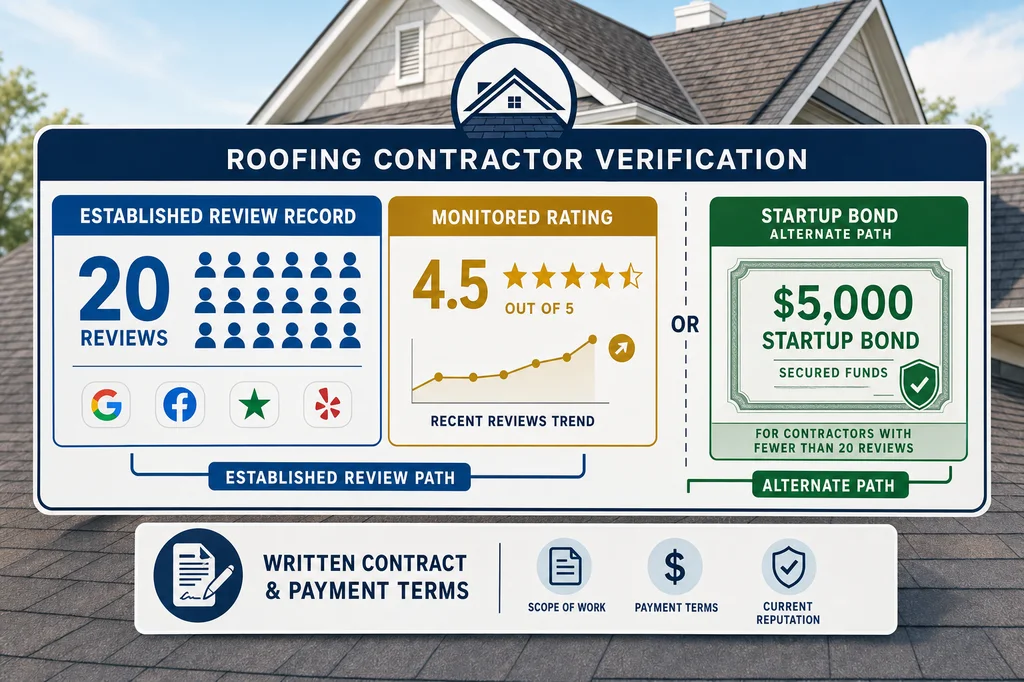
Directorii’s 20-review, 4.5-star monitoring, and $5,000 new-contractor bond standard are signals homeowners can consider when evaluating a listed roofer. They can help narrow the field, but they should not replace reviewing the written scope, payment terms, and current reputation.
Why 20 online reviews can be more useful than a business-age claim
A contractor’s years in business do not necessarily show how many homeowners the company has served or how it handled those jobs. Twenty solid online reviews can give you a larger body of customer feedback than a newly formed company with an older registration date.
The stated standard accepts reviews from more than one platform. Google was the original reference point, but Yelp may be considered for contractors with an established Yelp presence, and Thumbtack reviews may also be substituted. That matters because a low Google review count alone may not tell the full story.
The reasoning behind the 20-review threshold is straightforward: it is intended to show that a contractor has completed work for enough customers to generate a meaningful public record. The speaker estimated that only about one in five customers leaves a review when asked. That estimate is not a guarantee of how any particular company performs, but it explains why 20 reviews may reflect substantially more completed customer relationships.
How a 4.5-star minimum changes the way you read ratings
A high overall score is useful only if it remains high over time. The stated policy is to monitor a listed contractor’s profile and flag a rating that falls below 4.5 stars.
For you, the practical value is not the decimal alone. Read the most recent reviews and look for a pattern. A contractor can have a strong lifetime average while recent customers report delayed work, missing communication, deposit disputes, or unfinished jobs. Those complaints may signal that the company’s current capacity or finances have changed.
- Check recency. Recent reviews are more useful for spotting a current service decline than older praise.
- Read low-star reviews in full. Focus on repeated issues, not a single complaint that lacks detail.
- Separate workmanship from scheduling. Both matter, but repeated reports of money collected without work starting deserve especially careful attention.
- Compare review platforms. A contractor may have a more complete history on Yelp or Thumbtack than on Google.
What the $5,000 startup bond is meant to signal
The $5,000 bond option is described for a contractor that does not yet have 20 online reviews. Under that approach, the contractor places $5,000 with the platform until it reaches the review threshold; the amount was described as refundable once the contractor has 20 reviews.
This is not the same as proof that a new contractor has years of successful roofing work. It is a financial participation requirement intended to reduce the risk of listing a business with little public history. The speaker characterized it as evidence that the company has at least some funds available if a mistake occurs.
That distinction matters. A bond amount should not be treated as a promise that every possible defect, delay, dispute, or loss will be paid. Before you rely on any bond, guarantee, or project-protection statement, get the applicable terms in writing and read what events, exclusions, and procedures apply.
Why deposits and supplier payment still need your attention
Reviews and screening can reduce uncertainty, but they cannot make fraud or business failure impossible. The speaker described two past claims of about $4,000 each: one involving a supplier lien after a contractor failed to reimburse a supplier, and another involving a contractor who took a deposit and then stopped responding.
The homeowner lesson is to understand where your money goes and what documents you will receive as work progresses. A written contract should identify the contractor, scope, materials, payment schedule, and what happens if the scope changes. Keep copies of payments, communications, permits if required locally, and supplier-related paperwork provided for your project.
If a supplier raises a payment issue or you receive a lien-related notice, do not assume a roofer’s verbal explanation resolves it. Requirements and deadlines vary by state and contract. Review the notice promptly with a qualified local attorney or your state consumer or insurance office.
Directorii lists verified contractors.
A homeowner checklist for comparing a newer listed roofer
A newer company is not automatically a poor choice, but it gives you less public history to evaluate. Use the available review record and written project details together before making a deposit decision.
- Count the reviews on the platform where the contractor is strongest. Confirm that the total is real and visible, rather than relying on a screenshot or a sales claim.
- Review the rating and the latest complaints. Look for recurring concerns about deposits, schedule changes, incomplete work, or communication.
- Ask whether the company is operating under the same name shown in the reviews. A review history is most useful when it clearly belongs to the business signing your contract.
- Request the full written scope before paying. The document should make clear what roofing work and materials are included.
- Read any bond or protection terms yourself. Confirm what is actually offered for your project rather than treating a listing status as a substitute for contract terms.
Questions that clarify a thin review history
If a contractor has fewer reviews, the key question is whether there is a clear, documentable explanation and a workable project plan. Give more weight to records you can review than to broad assurances.
- Which review platforms are being counted toward your listing standard?
- Are the reviews under the same business name that will appear on my contract?
- How does the $5,000 bond arrangement apply while a contractor has fewer than 20 reviews?
- What written terms apply if there is a complaint about my project?
- What is included in my scope, and what could trigger a change order?
Source: YouTube video
FAQ
What review standard is used for a listed Directorii contractor?
The stated standard requires 20 solid online reviews and a minimum 4.5-star rating. Reviews may come from Google, Yelp, or Thumbtack rather than one platform alone. You should still read the newest reviews, especially lower-star comments, because a lifetime rating may not show a recent pattern of delays or disputes.
Can a roofer be listed before reaching 20 reviews?
Yes, the stated approach allows a newer contractor with fewer than 20 reviews to use a $5,000 bond option. The amount was described as refundable after the contractor reaches 20 reviews. Treat that arrangement as one screening signal, not as a substitute for reviewing the contractor’s written scope and project terms.
Does a 4.5-star rating mean a roofing contractor is risk-free?
No, a 4.5-star rating is a reputation signal, not a guarantee of your project outcome. Read recent reviews for repeated concerns about deposits, unfinished work, communication, or long delays. Then compare those findings with the company’s contract, payment schedule, and the specific work proposed for your home.
Why should I care about where a roofer’s reviews are posted?
The review platform can matter because some contractors may have a fuller customer history on Yelp or Thumbtack than on Google. Check that the reviews belong to the same business that will sign your contract. A large review count is less helpful if the company name or ownership connection is unclear.
What should I do if a supplier sends me a lien-related notice?
Take the notice seriously and review it promptly with a qualified local attorney or the appropriate state consumer or insurance office. Lien rules and notice requirements vary by state and contract. Keep your contract, payment records, communications, and any supplier documents connected to the roofing project.