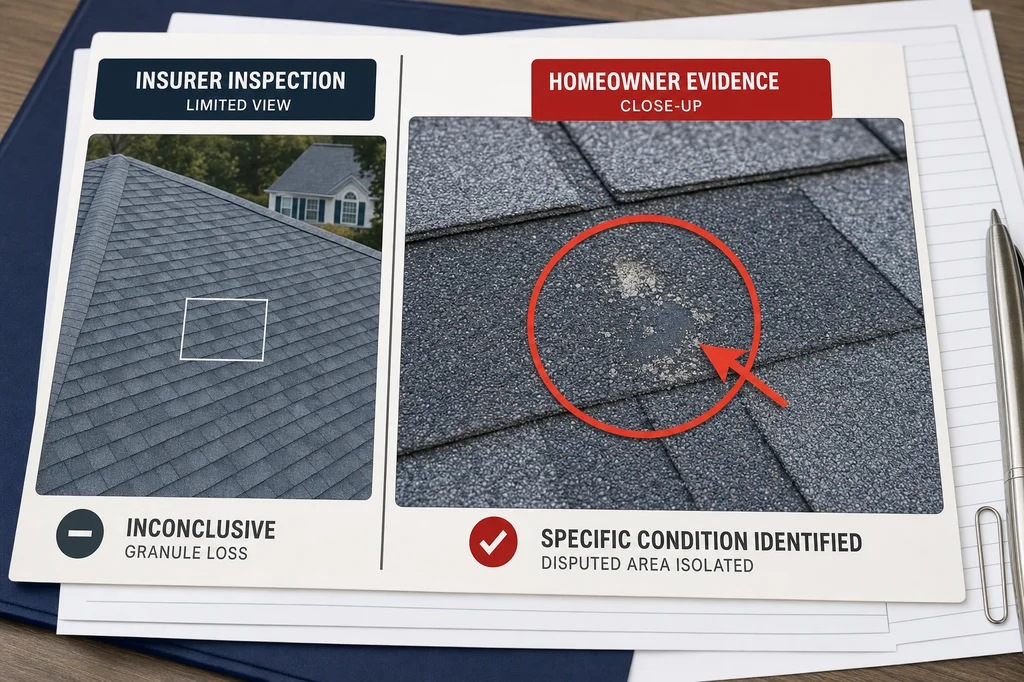
Documenting a denied roof claim with annotated photos can help build a focused record for a desk reviewer. Compare your evidence with the insurer’s inspection, identify unanswered findings, and keep a record that supports a measured escalation if communication stalls.
Start with the insurer’s stated reason for denying the roof claim
Your response should address the actual reason for the denial, not simply repeat that your roof was damaged. A broad collection of roof photos may be less useful than evidence that responds to the insurer’s stated finding point by point.
Read the claim decision and separate its conclusions into individual items. For example, the insurer may characterize a mark as ordinary granule loss rather than storm damage, or rely on photos taken from a limited viewpoint. Your documentation should identify where you disagree and show the visual basis for that disagreement without overstating what a photo proves.
- Insurer finding: Copy the specific conclusion being disputed.
- Your photo reference: Identify the photo or set of photos that addresses that conclusion.
- What the image shows: Describe visible conditions, such as displaced granules in a circular pattern, crushed granules, or an apparent puncture through the fiberglass matting when those conditions are actually documented.
- Why it matters: State the narrow question the photo raises about the inspection conclusion.
- Professional support: Include a roofer’s written observations if a qualified roofer inspected the roof.
This format keeps the dispute concrete. It asks the insurer to evaluate identified evidence rather than guess what you want reconsidered.
Why annotated photos are stronger than an unorganized photo dump
Annotated photos can make the evidence usable for someone reviewing a claim from a computer. The useful part is not the drawing itself; it is the connection between a clearly marked condition and the insurer’s stated conclusion.
A former contractor and public adjuster, Sam Cook, described using photo software to mark images and show the specific features relied on in a claim dispute. He contrasted that with an insurer photo that may simply label a condition as granule loss without showing what testing or visual basis led to that conclusion. That is a reported claims tactic, not a manufacturer specification or a guarantee that any marked spot is covered damage.
Ask a roofing professional to document the roof from safe access. Do not climb onto the roof to gather close-up evidence. A professional can take consistent photos, note locations, and explain construction-related observations that are hard to interpret from ground-level pictures.
Build a point-by-point comparison to the insurer’s inspection
The most useful reconsideration package is a comparison, not a new sales estimate. Put the insurer’s inspection findings beside your own evidence so each disagreement can be evaluated on its own.
- List each disputed finding from the denial or inspection result.
- Match it to labeled photos taken from the same roof area when possible.
- Use arrows, circles, or short labels to identify the exact condition under review.
- Add the roofer’s concise written observation about that condition and its location.
- Identify what is missing or unclear in the insurer’s inspection record, such as a lack of close-up documentation for the area at issue.
- Request a written response to each item rather than a generic reinspection outcome.
Keep estimates honest. Cook cautioned against adding line items for work that will not be performed merely to increase a claim total. If chimney flashing, gutters, or another component is included, the scope should reflect work that is actually needed and intended to be completed. A stronger claim file is specific and truthful, not inflated.
Document noncommunication before contacting a state insurance regulator
A state insurance regulator may be an appropriate place to raise a documented communication problem, but it is not a substitute for proving the roof damage. Regulators and complaint processes vary by state, and a complaint does not promise a coverage change.
Maintain a simple communication log with dates, the person or department contacted, the claim number, the documents sent, and the response received. Save emails, upload confirmations, letters, and voicemail records. If the insurer has not responded to a clear, itemized request, send one concise follow-up that attaches the comparison and asks for a written status.
If communication remains unresolved, check your state insurance department or department of commerce for its complaint process. Submit factual records: the denial, your point-by-point response, the communication log, and proof that the materials were delivered. Avoid framing a complaint as a demand for a particular outcome. The practical goal is to create an accountable record of the communication issue.
Know when a public adjuster or attorney may be worth considering
Professional help may make sense when a denial remains in place after you provide organized evidence, when the policy language is central to the dispute, or when contract deadlines may affect your options. The right professional depends on the issue you need addressed.
A public adjuster can assist with documenting and presenting a property claim where licensed, but fees, authority, and licensing rules differ by state and contract. An attorney is the appropriate professional for legal interpretation, appraisal or lawsuit provisions, and any deadline in a policy’s suit-against-us or appraisal clause. Review those terms promptly rather than assuming a claim can remain open indefinitely.
The contractor you hire also matters. Choose a roofer who can provide an accurate repair scope and documented observations, rather than one who promises a larger insurance payment or bills for work that will not happen. Directorii lists verified contractors.
For background on the claims-documentation approach discussed here, see the Source: The Big Insurance LIE: Why Most Homeowners Never Get Paid What They're Owed.
FAQ
How should I document a denied roof claim with photos?
Document each disputed area with clear, labeled photos that directly address the insurer’s written finding. Pair every photo with a short explanation of what is visible, where it is located, and why it differs from the inspection conclusion. Have a roofing professional collect close-up roof evidence rather than accessing the roof yourself.
What should I write on annotated photos for a roof claim?
Write only what the image can support, such as the location and visible condition being reviewed. Arrows or circles can identify displaced granules, a circular mark, or another documented feature. Do not label a condition as covered storm damage simply because it is marked; connect it to a roofer’s observations and the insurer’s stated finding.
Can I challenge an insurer’s roof inspection after a denial?
You can ask the insurer to review a focused response to the denial. A useful response compares each disputed inspection conclusion with your labeled photos and supporting documentation. Request a written answer to the individual points, but understand that a request for review does not ensure that the insurer will change its coverage decision.
When should I contact my state insurance regulator about a roof claim?
Consider the state insurance regulator when you have a documented communication problem that remains unresolved after clear follow-up. Keep the denial letter, your itemized response, delivery records, and a dated communication log. State complaint procedures vary, and the regulator may review conduct or communication without deciding that your roof loss is covered.
Should I hire a public adjuster after my roof claim is denied?
A public adjuster may be worth considering if the claim needs substantial documentation, policy-based analysis, or sustained communication with the insurer. Confirm the adjuster is licensed where your property is located and review the fee agreement carefully. If legal rights, appraisal provisions, or policy deadlines are involved, consult a qualified attorney.