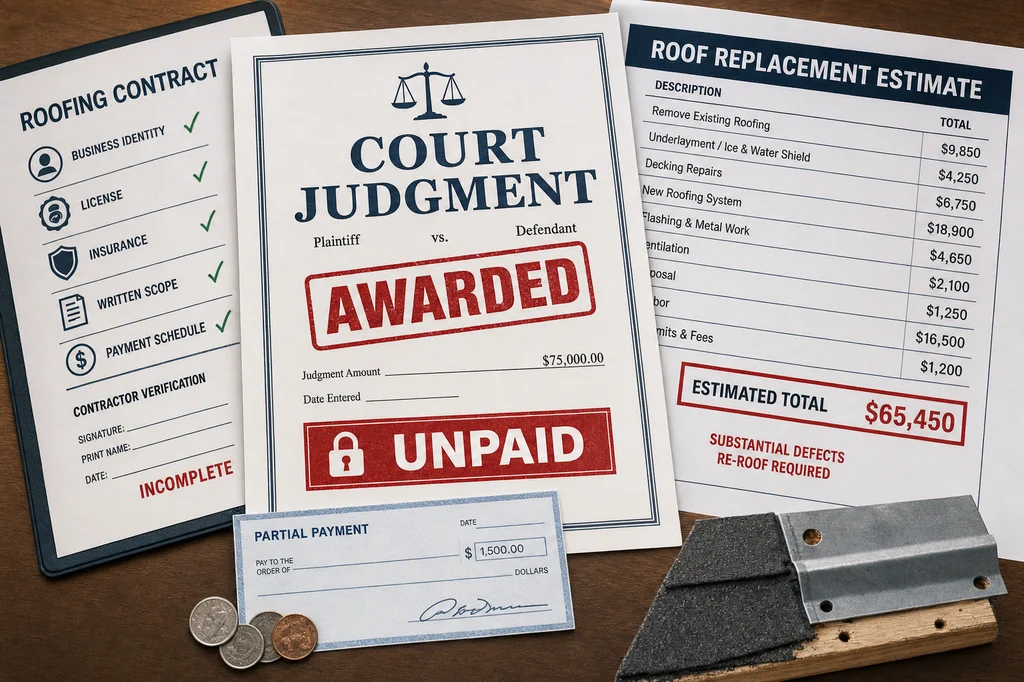
The Davis Construction roof case shows why collecting a court judgment after defective roofing work can remain difficult even after a homeowner wins. Renee York reportedly won her case but had received only about $200 toward the judgment, while facing an estimated $18,000 cost to remove and redo the roof work.
Why a court win may not turn into roofing-repair money
A judgment establishes what a court decided, but it does not necessarily mean the contractor will promptly have reachable money or assets to pay it. York’s experience is a painful example: court records reportedly showed that Melvin Davis was found in contempt for not making payments, yet payment remained limited.
That distinction matters before you spend more money pursuing a case. A civil claim may help document the dispute and establish a judgment, but collection procedures, available assets, and enforcement options can depend on state law and the facts of the case. A local attorney or court self-help office can explain the collection process available where you live; a roofing contractor should not be treated as the authority on legal remedies.
The homeowner lesson is preventive: investigate the business before a large deposit or final payment changes hands. A roof repair that appears limited can create much larger costs if water enters around a chimney, pipe, or another roof penetration and damages ceilings, walls, insulation, or finishes.
What the Davis Construction allegations should make you verify
The reported warning signs were concrete, not subtle. York said Davis Construction’s work looked unfinished, with missing screws and pieces of metal placed where they did not belong. She said three roofers who later evaluated the roof told her it needed to be removed and redone.
In the case, the address used by Davis Construction on contracts belonged to a different business. The company was also described as not licensed, insured, or bonded. Those are case-specific findings and should not be assumed about any other roofing company. They do show why a referral alone is not enough evidence that a contractor is established and accountable.
- Business address: Search the address independently and confirm it is genuinely tied to the company you are considering. A contract address that belongs to an unrelated business is a serious reason to pause.
- License status: Check the applicable state or local licensing record when your area requires roofing licensing. Confirm the business name matches the contract.
- Insurance: Request proof of insurance and verify the information with the carrier or agent named on the document. Do not rely only on a verbal assurance.
- Written scope: Make sure the agreement identifies the repair area, materials, flashing or metal work, and how the work will be completed. Vague language makes a later workmanship dispute harder to sort out.
- Payment schedule: Read when money is due and what work must be complete before each payment. Avoid treating a signed contract as proof that the contractor is financially stable or easy to locate later.
Project bonds are extra security, not a default promise
A project bond may add a layer of financial security, but it is not something every roofer automatically carries. Bonds may be obtained for a particular job rather than carried as a standard feature of every residential roofing company.
If a bond matters to you, raise it before signing rather than after a dispute begins. Ask whether the contractor can obtain one for your project and review the bond documents before relying on it. Bond availability, cost, and requirements can vary by project and location.
Do not confuse a bond with insurance. They are different arrangements, and neither should be accepted as a substitute for checking the contractor’s identity, address, contract, and work history.
Respond early when roof work looks incomplete or wrong
Visible unfinished work, loose-looking metal, missing fasteners, or water entering the home calls for prompt professional evaluation. You should not climb onto the roof to inspect or correct the work yourself. A licensed roofer can assess the condition from a safe, professional standpoint and identify whether the issue is limited or whether removal and replacement may be necessary.
- Document what you can safely see. Keep dated photos from the ground or interior, copies of the contract, payment records, texts, emails, permits, and any written estimates for correction.
- Limit further damage. If there is active leaking, seek qualified help to protect the home and identify the source. Water intrusion can spread beyond the original repair area.
- Get independent written evaluations. York said three roofers assessed the work and concluded it needed a full redo. Separate assessments can help you understand the repair scope without relying on the original installer’s account.
- Keep communications factual. State the observed issue, the contract item involved, and the remedy you are seeking. Save responses and missed commitments.
- Get legal guidance before escalating. If payment, liens, insurance, or a lawsuit becomes part of the dispute, consult a qualified attorney in your state about your options and records.
Directorii lists verified contractors.
When a referral deserves a second check
A referral can introduce you to a contractor, but it should not replace verification. York said she hired Davis Construction after a family member referred the company. The case illustrates that a familiar recommendation may still leave unanswered questions about a business’s address, credentials, insurance, and ability to stand behind its work.
Source: Davis Construction roof-case report and commentary
FAQ
Can I collect money right away after I win a case against a roofing contractor?
Not necessarily. The Davis Construction case illustrates that a homeowner may win a judgment yet still receive little payment. Collection can depend on the contractor’s available assets and the legal procedures in your state. Speak with a qualified local attorney or court self-help office about enforcement options and the records you need.
What should I verify before paying a roofing contractor?
Verify the company’s real business address, applicable license status, insurance documentation, business name, and written scope of work. The Davis Construction address was tied to a different business, showing why a contract address should be independently checked rather than accepted at face value.
Should I ask a roofer for a project bond?
You can ask whether a contractor can obtain a bond for your specific project if you want added security. A bond is not automatically carried by every residential roofer and may be arranged job by job. Review the bond documents before relying on it.
What if roofing work looks unfinished or starts leaking?
Document the visible and interior conditions safely, preserve your contract and payment records, and arrange a professional evaluation. Do not go onto the roof to inspect or fix the work. Water entering around roof penetrations can lead to broader interior damage, so prompt assessment can help define the needed repair.
Is a family referral enough reason to hire a roofing company?
No. A referral may be useful, but it is not a substitute for checking the contractor’s address, credentials, insurance, and contract details. Renee York said Davis Construction was referred by a family member, yet the later dispute involved reported concerns about the company’s work and business information.