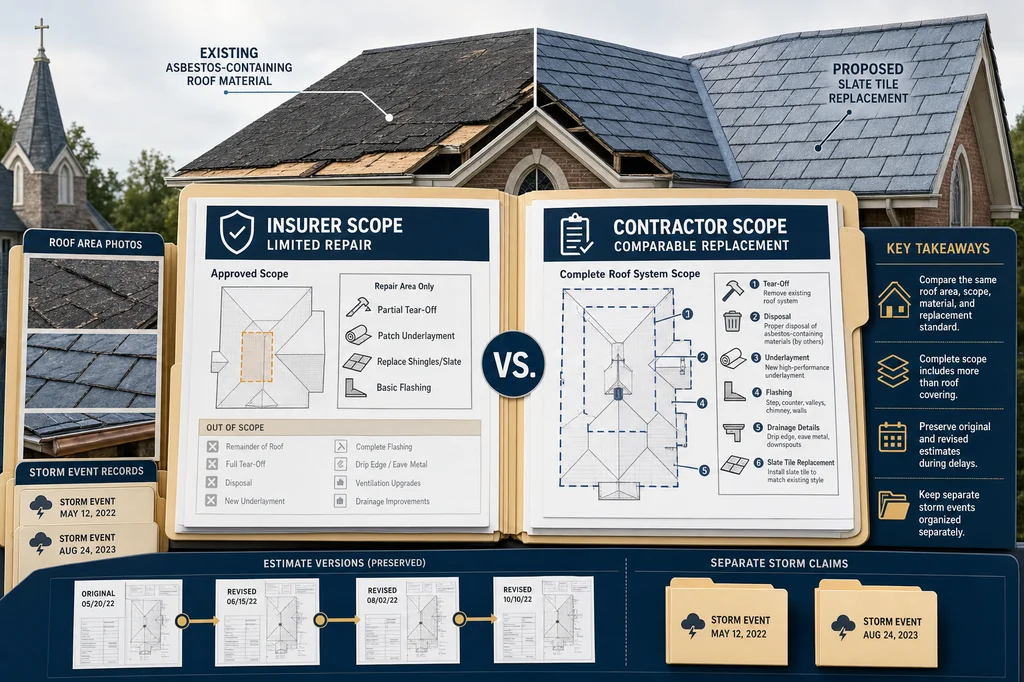
The Central Baptist Church v. Church Mutual dispute shows why church boards should preserve dated, comparable-replacement estimates when a storm-damage roof claim is delayed or severely lowballed. It also underscores the need to track changes after later storms and seek qualified legal and insurance guidance before a claim becomes contested.
Why comparable replacement became the central issue
The key disagreement was not simply whether the roof had storm damage. It was whether the proposed repair amount reflected a comparable replacement for the existing roof.
Central Baptist Church reported storm damage in 2014 and filed a claim with Church Mutual. Church Mutual reportedly estimated repairs at a little over $2,000. The church obtained two contractor estimates putting replacement near $1.4 million. The difference centered on the existing roof, which was described as asbestos-containing, and the contractors’ position that slate tile was a comparable replacement under the policy.
For a church board, that gap is a warning sign to slow down and preserve the basis for every number. A low insurer estimate and a higher contractor estimate do not automatically prove either side is right. But a board needs enough detail to show whether the estimates are pricing the same scope, the same roof system, and the same replacement standard.
A useful comparable-replacement file should identify:
- The existing roof materials: Record the roof’s known material, condition, and affected areas before removal changes the evidence.
- The proposed replacement material: State why the specified material is being proposed as comparable, rather than merely listing a product name.
- The complete work scope: Separate roof covering, tear-off, disposal, underlayment, flashing, drainage details, and other work included in the estimate.
- Photos and dated observations: Keep images tied to roof elevations or building areas, not an unlabeled collection of pictures.
- Estimate versions: Save the original scope and every revision, including the date and reason for the revision.
In plain English, the board should be able to place the insurer’s scope beside its own replacement scope and identify exactly what differs. A licensed roofing professional can prepare and explain the construction scope; coverage interpretation belongs with the insurer, a qualified insurance professional, or counsel.
Do not let a later storm claim blur the earlier loss
Separate storm events need separate, organized records. Central Baptist’s dispute became more complicated after another hurricane led to a new claim under a different insurer.
The later claim did not account for the earlier regional damage. Church Mutual then argued that Central Baptist had withheld information and alleged fraud. At trial, Church Mutual reportedly walked back those fraud claims, and the judge did not accept the argument as presented.
This does not create a rule for every church or every policy. It does show why a board should maintain a clear claim timeline whenever the roof is damaged again before the first dispute is resolved. Keep claim numbers, carrier correspondence, inspection dates, storm dates, repair invoices, photos, and contractor scopes in separate folders. Note which roof areas each document addresses.
That chronology can help your licensed professionals distinguish an earlier loss from later damage. It can also prevent the board from giving inconsistent descriptions of the roof’s condition as events unfold.
Preserve pricing changes during a long claim delay
A delayed claim can make an old estimate less useful if replacement costs change. Central Baptist presented evidence that prices had increased during the delay, and the jury ultimately awarded the church $1.75 million; an appeals court later upheld that verdict.
The property-owner lesson is documentation, not an assumed right to recover every later increase. If your church’s claim remains unresolved, retain dated estimates and updated scopes rather than relying on a single early proposal. If a contractor revises pricing, keep both versions and the explanation for the update.
Do not replace the prior file with the newest estimate. The older document may show what the project cost at a particular point in the claim, while the later version may show why the original amount no longer reflects the work needed. Whether updated costs affect coverage or damages can depend on the policy, the facts, and applicable law. Get advice from qualified counsel or your state insurance department rather than relying on a roofing company to decide that question.
What a church board should request before challenging a low scope
Your strongest response is a clear written record that compares competing scopes. Start by requesting the documents that let your board and its advisers see what the insurer actually approved or excluded.
- Request the insurer’s detailed estimate. Ask for the line-item scope, not just a payment amount or summary letter.
- Obtain a detailed roofing estimate. The contractor’s proposal should identify affected building sections, material assumptions, removal and disposal, and the replacement system proposed.
- Match documents by roof area. A proposal for the entire campus roof cannot be fairly compared with an insurer scope for only one section.
- Keep written communications. Save emails, letters, claim notes you receive, and responses to requests for clarification.
- Use qualified advisers for their proper roles. A roofer can explain construction and pricing; an attorney or licensed insurance professional can advise on policy disputes, accusations, and legal strategy.
Do not rely on verbal assurances that a material or system is “comparable.” Ask for the construction reasoning in writing. If asbestos-containing materials are involved, the board should also use properly qualified professionals for evaluation and handling requirements.
Choose a roofer who can document the scope without deciding coverage
The contractor’s role is especially important when the proposed replacement is unusual or the insurer’s scope omits major work. You need a roofer who can provide a precise construction estimate and answer factual questions about the roof system without promising a claim outcome.
Before signing a roofing contract, review how the contractor describes the existing roof, the replacement material, and every included task. A vague lump-sum proposal gives the board little to compare against an insurer estimate. A detailed scope also makes it easier to identify whether the real dispute is material choice, roof area, damage causation, removal work, or another specific item.
Directorii lists verified contractors.
Use the Central Baptist result as a records warning, not a guarantee
Central Baptist’s result shows that a church can continue challenging a sharply disputed roof valuation, but it does not predict how another claim will end. Policies differ, evidence differs, and later storms can create factual disputes that require careful professional review.
The practical takeaway is to preserve comparable-replacement estimates early, update them when circumstances change, and keep each storm event distinct. Those records give your board a better foundation for a coverage discussion or legal advice if the claim becomes contested.
Source: Georgia Church WINS $1.75 Million After 10 Year Insurance Battle
FAQ
What should a church save if its Church Mutual roof claim is delayed?
Save the insurer’s detailed estimate, contractor scopes, photos, correspondence, claim information, and dated estimate revisions. Central Baptist’s dispute involved a major gap between the insurer’s repair figure and contractor estimates for a comparable replacement. A complete record helps your board compare specific scope differences instead of arguing only about the final total.
How can a church show that a roof replacement is comparable to the existing roof?
A church should obtain a written roofing scope that identifies the existing material, proposed replacement material, affected roof areas, and the reasoning for comparability. In Central Baptist’s case, contractors reportedly identified slate tile as comparable to the asbestos-containing original roof. Policy interpretation should be reviewed with qualified insurance or legal advisers.
Can a later hurricane claim affect an earlier roof claim dispute?
Yes, a later storm can complicate an earlier dispute because the parties may disagree about which event caused particular damage. Central Baptist had a later hurricane claim under a new insurer, which became part of the dispute. Keep separate timelines, photos, claim numbers, estimates, and correspondence for each event.
Should we update a roofing estimate while an insurance claim is unresolved?
Yes, keep the original estimate and preserve updated versions when pricing or the scope changes. Central Baptist presented evidence that prices increased during the long delay. An updated estimate does not guarantee additional coverage, but dated versions can document how replacement costs and project assumptions changed over time.
What should a church board do if the insurer’s roof estimate is far below contractor estimates?
Start by comparing the detailed scopes line by line to identify missing areas, materials, removal work, or other differences. Request written clarification from the insurer and obtain a detailed proposal from a licensed roofer. For coverage disputes, claim accusations, or legal questions, consult qualified insurance and legal professionals rather than relying on a contractor alone.