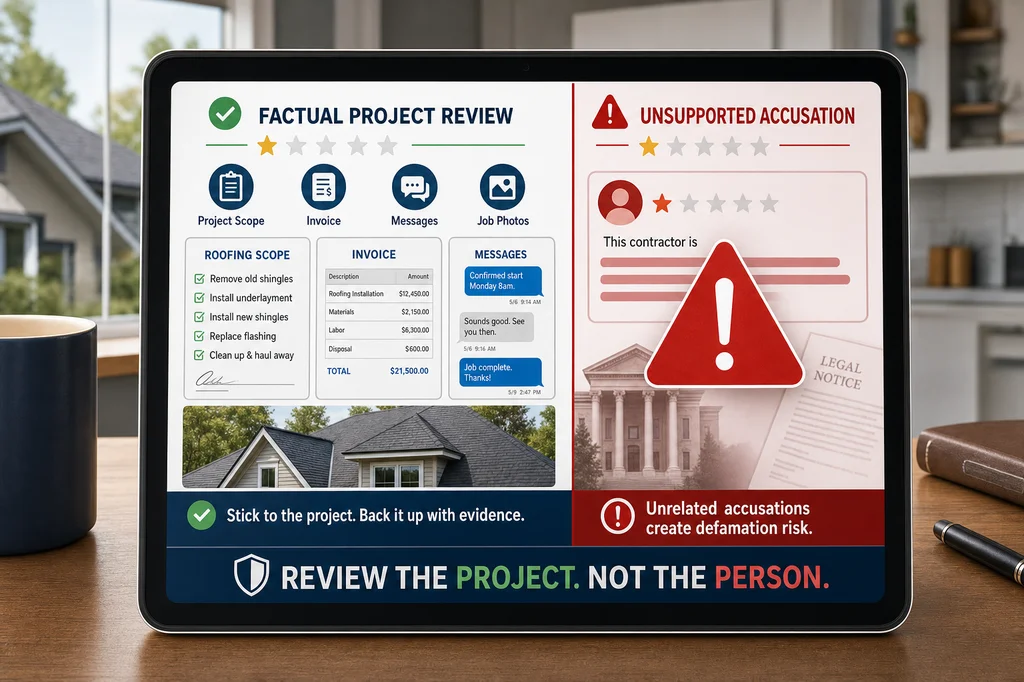
A one-star review can tell homeowners about a bad roofing project. It can also become a defamation dispute when it moves from the job itself to serious claims about a contractor’s personal or criminal history.
The sharpest example is a West Virginia handyman case. A customer posted that the handyman was a five-time felon, drug dealer, arsonist, and murderer. He had three felony convictions—for attempted meth trafficking, attempted arson, and possession of explosives—but no murder conviction. The judge found defamation and awarded $1 because the handyman did not prove actual loss.
The false murder claim was not a project complaint
The case was not about whether a homeowner may describe an unsatisfactory job. It centered on an accusation that went beyond the customer’s own project and included a crime the handyman had not been convicted of.
That difference matters when writing about roofing work. A review can explain what you hired a company to do, what you believe was missing or wrong, the records you have, and how the company responded. A review becomes far less useful when it adds allegations about crimes, private conduct, or rumors unrelated to the job.
The $1 award was symbolic, but the dispute still reached court. The case discussed several points that can matter in a defamation claim: whether a statement was untrue, whether it was stated as fact rather than opinion, whether it was published, fault, and damages. The details and applicable law can vary by state.
Put the project record at the center of the review
Use the review to give the next homeowner a clear account of your own experience. One concise structure is enough:
- Identify the agreement: “We hired the company for the written scope dated [date].”
- Describe the specific result: “The final work did not include [item]” or “We believe this work differed from the written scope.”
- Include the follow-up: “We contacted the company on [dates] and received [response].”
- Give your view: “We were dissatisfied and would not hire the company again.”
Keep the documents that support the factual parts of the review, such as the agreement, invoices, written messages, change orders, and photographs. A reader can assess a focused account of the work more easily than a review built around insults.
A court outcome can be the project fact worth sharing
Another case discussed involved homeowner complaints against Robert Meyers Companies after a new-home project stalled over permits and driveway rules. The court found that the company had allowed its registration to lapse and had failed to provide required disclosures. The homeowner received $54,750.
Afterward, the homeowner made broader accusations in emails, online, and at public meetings, including claims that the builder was a cheat, thief, liar, admitted criminal, and responsible for a customer’s death. The homeowner also created a website calling the builder “the house builder from hell.” The builder won $100,000 for defamation.
The useful review did not need those personal allegations. The homeowner could have stated the project dispute and the court result: the company was found to have let its registration lapse, failed to provide required disclosures, and the homeowner received $54,750. That is a concrete account connected to the homeowner’s own job.
Keep a firm review narrow and specific
A strong negative review does not need to declare that a contractor is a criminal or speculate about motives. State what occurred on your project and distinguish that account from your recommendation. For example: “The written scope included [item]. We believe the final work omitted it. We contacted the company on [dates], and we were dissatisfied with the response. We would not hire this company again.”
If you are considering publishing allegations of criminal conduct or receive a demand over a review, preserve your records and seek advice from a licensed attorney in your state.
Directorii lists verified contractors.
Source: Defamation Wars: When Roofers and Homeowners Go Too Far with Reviews
FAQ
Can a contractor sue over a homeowner review?
A contractor can bring a defamation claim over a review. In the West Virginia handyman case, a customer’s murder allegation was false, and the judge found defamation. The handyman received $1 because he did not prove actual loss.
What was false in the West Virginia handyman review?
The review called the handyman a five-time felon, drug dealer, arsonist, and murderer. He had three felony convictions for attempted meth trafficking, attempted arson, and possession of explosives, but no murder conviction.
What should a negative roofing review include?
Keep it tied to your project: the written scope, the specific work you believe was incomplete or different, your contacts with the company, its response, and your own recommendation. Retain the records supporting factual statements.
Can I mention a court result in a contractor review?
A court result directly connected to your own project can provide a specific account of the dispute. In the Robert Meyers Companies matter, the homeowner received $54,750 after findings involving a lapsed registration and required disclosures. The later personal accusations produced a separate defamation award for the builder.
Should I accuse a contractor of a crime in a review?
Avoid criminal accusations and unrelated personal claims. The handyman case shows how a false murder allegation can turn a review into a defamation dispute. If you are considering serious allegations, preserve your records and seek advice from a licensed attorney in your state.