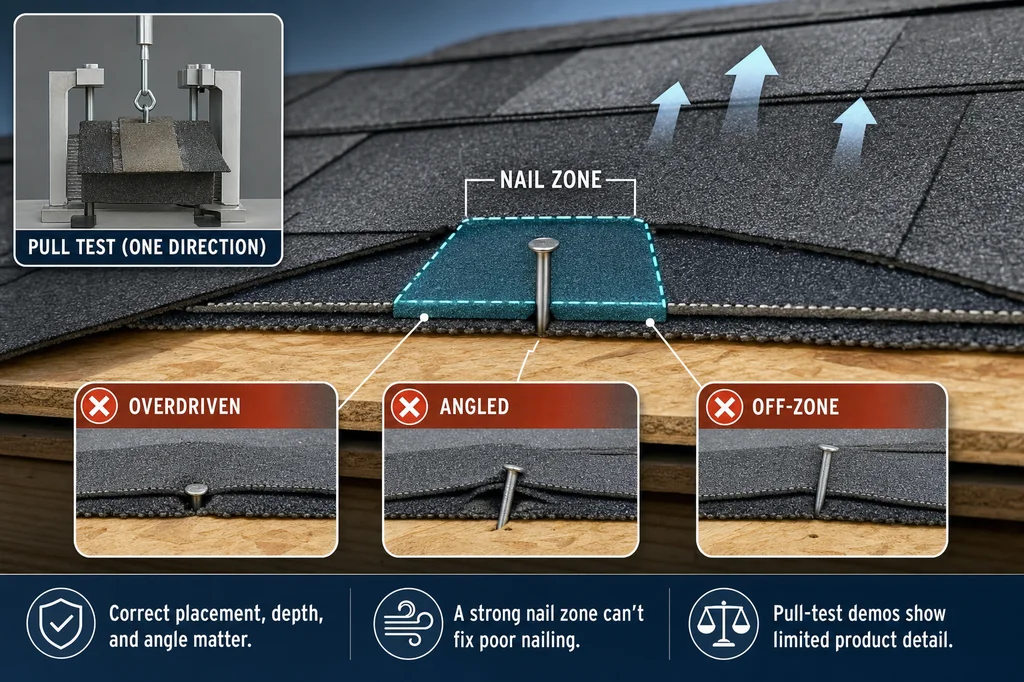
Asphalt-shingle pull-test demos involving Tamko, Owens Corning, and IKO can show how a nail zone performs in a controlled display, but they are not a complete measure of roof performance. Your final choice should put more weight on proper nail placement, nail depth, and installation quality than a dramatic trade-show result.
What a nail-zone demo actually measures
A pull test is a visual demonstration of how much force is needed to lift a shingle around its nailing area. It can make one product’s nail-zone design easier to see, but it does not duplicate the way wind acts on an installed roof.
Trade-show versions can be especially theatrical. At a Tamko demonstration, containers of water created pulling force, while other displays used different setups. A shingle being pulled in one direction on the ground is not facing the changing pressure and uplift forces that occur during wind.
That does not make the nail zone irrelevant. A well-designed nailing area can give an installer a clearer target. It does mean a pull-test result should be treated as one limited product detail, not as proof that a roof will resist wind better than every alternative.
Why expo pull-test results are not a brand ranking
Head-to-head booth demonstrations can change based on the shingles selected and the way the test is set up. The reported results involving Tamko, Owens Corning, and IKO did not produce one consistent winner.
At an Owens Corning booth comparison in 2018, IKO reportedly outperformed Owens Corning after it was added to the display. In a separate comparison, Owens Corning reportedly beat IKO. At a Colorado expo, a Tamko demonstration also reportedly had its own shingle fail after a competing sample performed well.
For a homeowner, the useful lesson is simple: do not treat a brand’s chosen comparison sample as an independent ranking of every shingle on the market. A demo may be worth watching if you want to understand the nail-zone concept, but it is not a substitute for comparing the actual products and installation plans in your estimates.
Installation can erase a stronger nail zone
Even a shingle with a strong nail zone can fail if nails miss that area or are driven improperly. Nail-gun pressure, nail depth, and nail angle can all affect how the shingle is secured.
This is the bigger decision behind the asphalt shingle pull test meaningful question. The product may offer a useful nailing target, but the crew still has to hit it consistently. A nail driven too deeply, at an angle, or outside the intended zone can reduce the benefit that the demonstration is meant to show.
Do not try to inspect or adjust roofing work from the roof yourself. Instead, focus on the installation controls a roofing professional plans to use and the details they are willing to document before work starts.
How to compare Tamko, Owens Corning, and IKO beyond a demo
Choose between Tamko, Owens Corning, and IKO by comparing the exact shingles offered and the installation plan, not by assuming one pull-test clip settles the question. All three brands have appeared in public nail-zone demonstrations, yet reported outcomes varied.
- Match the product names on each proposal. A brand comparison is only useful if you know which specific shingle each contractor is offering.
- Identify the nail-zone feature being promoted. Ask the estimator to point out what the selected product’s nailing area is intended to help the installer do.
- Compare the crew’s quality-control approach. The meaningful issue is whether nails will be placed at the proper depth and angle in the correct area.
- Separate marketing from the written work scope. A booth demonstration is promotional material; your estimate should describe the roof work you are buying.
A product demo may help you narrow questions, but it should not override a clear installation plan. If two proposals use different brands, ask each roofer to explain the practical installation difference they expect from the specific shingle they quoted.
Get nail placement and quality checks into the roofing scope
A written installation plan is more valuable than a promise that a shingle has a better pull-test result. It gives you a concrete way to compare how competing roofers intend to install the material.
Before signing, ask for a clear explanation of how the crew will set and check nail-gun pressure, nail depth, nail angle, and placement within the selected shingle’s nailing area. Also ask how the crew will address nails that are driven too deep, crooked, or outside the intended zone. These are not minor details if the nail zone is part of the product’s selling point.
If an estimator relies heavily on a live demo or brand claim but cannot clearly describe the installation controls for your roof, that is a reason to slow down and compare proposals. Directorii lists verified contractors.
Use pull tests as a question, not a verdict
A pull test can be useful for showing why the nailing area matters. It becomes less useful when it is treated as a guarantee of real-world roof performance or as a reason to ignore how the shingles will actually be installed.
Use the display to ask better questions about the shingle and the crew’s process. Then make your decision from the specific product, the documented scope, and the installer’s plan for proper nail placement.
Source: YouTube
FAQ
Are asphalt shingle pull tests meaningful when choosing a roof?
They can show how a shingle’s nail zone responds in a controlled demonstration, but they do not fully represent wind acting on an installed roof. Use a pull test as one product detail rather than a complete ranking. Proper nail placement, depth, angle, and installation quality can have a major effect on how the shingles perform.
Should I choose Tamko, Owens Corning, or IKO based on a pull test?
No single pull-test result should decide among Tamko, Owens Corning, and IKO. Reported public comparisons have produced varying results, including cases where different brands outperformed each other. Compare the exact shingles in your proposals and the roofing crew’s plan for placing nails correctly in the intended nailing area.
Why can a shingle fail even if it has a strong nail zone?
A strong nail zone cannot overcome improper installation. A nail that misses the intended area, is driven too deep, or enters at an angle may reduce how securely the shingle is fastened. The product feature and the installer’s nail-gun setup and workmanship need to work together.
What should I ask a roofer about shingle nail placement?
Ask how the crew will control nail-gun pressure and check nail depth, angle, and placement in the selected shingle’s nailing area. Ask how incorrectly driven nails will be handled. Request a clear written explanation before work begins, rather than relying only on a general claim that a brand has a stronger nail zone.
Can a trade-show shingle demo predict wind performance on my house?
A trade-show demo cannot fully predict wind performance on your house because a manual pulling setup does not reproduce the way wind loads a roof. It may illustrate a nail-zone feature, but your roof’s performance also depends on consistent installation. Review the proposed installation approach with a qualified roofing professional.