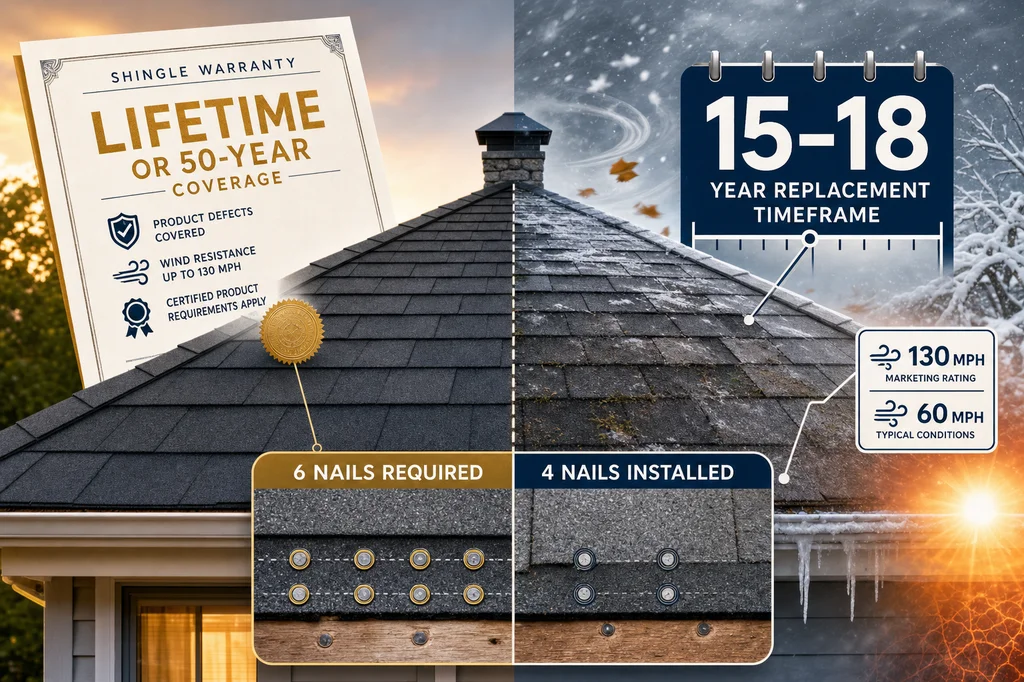
A 50-year or lifetime shingle warranty can sound like a prediction about the roof itself. Dimitri Lipinski argues that asphalt-shingle roofs are commonly replaced after about 15 to 18 years. His point is not that every roof fails on that schedule. It is that a lifetime label should not be treated as a forecast of how long an asphalt roof will remain in service.
Before choosing a shingle, get the exact written warranty and compare its installation requirements with the promise being made. Four details stand out: nail count, how installation will be documented, what certification actually means, and how wind claims are described.
The 15-to-18-year question behind a lifetime label
Lipinski contrasts 50-year and lifetime asphalt-shingle marketing with his estimate that many asphalt roofs are replaced in roughly 15 to 18 years. He attributes the shorter replacement cycle to northern snow, ice, and wind, and to southern heat.
That gap is the homeowner's starting point: do not accept “lifetime roof” as the whole answer. Ask for the warranty document, the exact shingle product name, and a clear explanation of what the manufacturer would do if it approved a claim.
Six nails required, four nails installed
The most specific claim scenario raised is simple: a manufacturer calls for six nails per shingle, but the roof was installed with four. Later, the shingles show cracking, major granule loss, buckling, or another performance problem. Lipinski says a manufacturer may point to the four-nail installation and deny the claim even if the reported shingle problem does not appear related to nail count.
Make the fastening requirement visible before work begins. Ask the contractor to identify the required nail count for the selected shingle, explain how installation will be documented, and provide the exact written warranty. Keep the contract, product information, invoices, and any installation photos you receive.
Do not walk on the roof to inspect fasteners. Request documentation from the contractor instead.
Why a certification sign is not the whole answer
Lipinski criticizes manufacturer certification programs as potentially easy to obtain. He describes asking about certification at an expo and receiving company-branded yard signs about two weeks later. He also says many manufacturers provide little installer training and do not routinely inspect completed jobs for compliance with their specifications.
A certification badge is not a substitute for product-specific answers. Ask which shingle will be installed, what the manufacturer requires for that product, and whether the crew can explain those requirements in writing. Obtain the exact warranty document rather than relying on a sales promise about upgraded or lifetime coverage.
A 130-mph claim versus shingles in 60-mph winds
Lipinski also challenges high-wind marketing with a pointed example: if shingles are advertised to withstand 130-mph winds, why might shingles allegedly come off in 60-mph winds three years after installation? He presents that contrast as a criticism of marketing claims, not as proof that every shingle with a 130-mph claim will fail at a lower wind speed.
Read the actual wind language before treating a large number in advertising as the expected result on your house. If storm damage occurs or a warranty claim is disputed, obtain the manufacturer's written position and consult a licensed professional or counsel as appropriate.
Questions worth putting in writing
- What is the exact shingle product and the exact written warranty?
- How many nails does the manufacturer require for this shingle?
- How will the contractor document that the required nail count and installation details were used?
- What does the written warranty say about wind coverage?
- What does the contractor's manufacturer certification mean for this specific installation?
Directorii lists verified contractors.
Source: Roofing Insights: 7 Ways Roofing Manufacturers Cheat Roofers and Home Owners
FAQ
Are lifetime shingle warranties real?
Lifetime and 50-year shingle warranties are marketed coverage terms, but Dimitri Lipinski argues they should not be treated as a prediction that an asphalt roof will last that long. He says asphalt-shingle roofs are commonly replaced after about 15 to 18 years.
Can four nails instead of six affect a shingle warranty claim?
Lipinski gives an example in which a manufacturer required six nails but found four, then used that installation issue to deny a claim involving cracking, granule loss, buckling, or another shingle-performance concern. Ask for the required nail count and written installation documentation.
Does a manufacturer certification prove the roof will meet warranty requirements?
Not by itself. Lipinski says certification can be easy to obtain and that manufacturer training may be limited. Ask for the exact written warranty and product-specific installation requirements instead of relying only on a certification badge.
Should a 130-mph wind claim be treated as a guarantee?
No. Lipinski questions 130-mph marketing by contrasting it with allegations of shingles coming off in 60-mph winds after three years. Read the written wind terms and do not treat a headline wind number as a blanket guarantee.