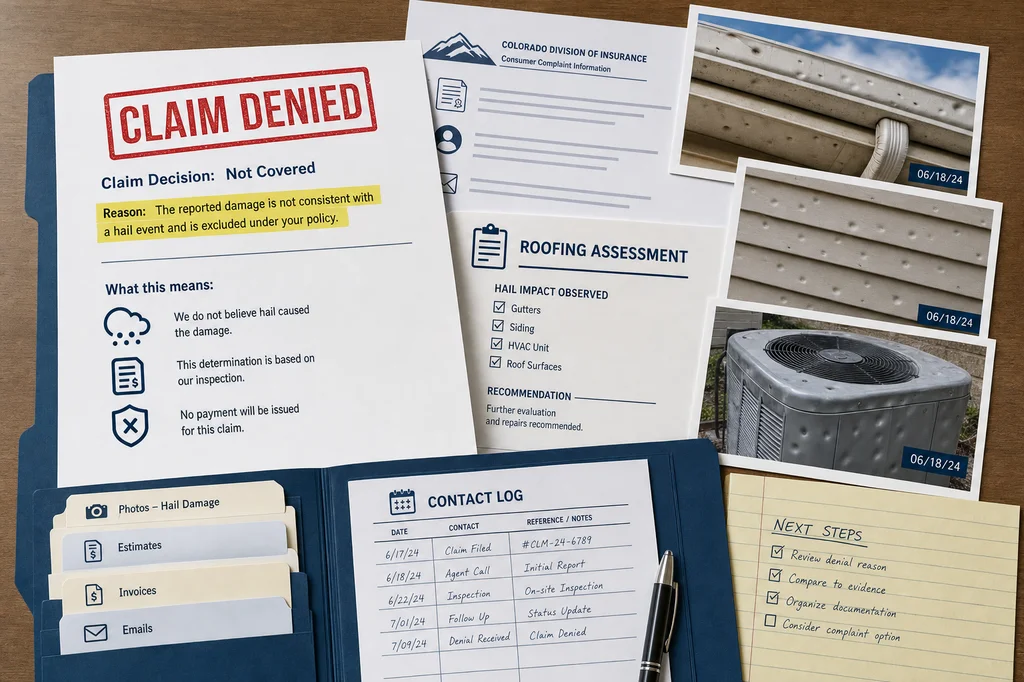
An Allstate Colorado hail-claim denial calls for a careful record, not a rushed repair decision. Preserve the visible damage, read the denial alongside your policy and claim documents, and use Colorado’s insurance complaint process if the explanation does not match the facts of your loss.
Start by preserving the condition of your property
Your strongest starting point is a clear record of what was damaged before weather exposure, cleanup, or repairs change the scene. Hail damage may affect more than roof coverings, so document the whole property without attempting to inspect the roof yourself.
In one reported Colorado farm claim, the owner pointed to damage on north-facing siding, air-conditioning equipment, and the roof. The claim was denied after Allstate reportedly said it could not see damage and that the loss did not exceed the homeowner’s deductible. That does not establish what will happen with your claim, but it shows why property-wide evidence matters.
- Photograph accessible damage: Take date-stamped photos of siding, windows, gutters, downspouts, outdoor equipment, fences, and other visible surfaces from the ground.
- Save storm-related records: Keep claim emails, letters, adjuster contact details, estimates, invoices, and photographs in one folder.
- Record changes over time: Note leaks, water marks, loose material found on the ground, or other new conditions after the storm. Seek prompt professional help for active water entry.
- Get a written roofing assessment: A qualified roofer can document observed conditions and identify what requires repair. A roofing assessment is not the same as an insurance coverage decision.
The practical goal is simple: make it easier to compare the insurer’s stated reason for denial with the actual condition of the property.
Read the denial for the exact reason Allstate gave
A denial letter is more useful when you break it into specific statements rather than treating it as a final explanation. Identify whether the insurer disputed storm damage, the amount of damage, the deductible, an excluded item, or something else under the policy.
Do not assume a neighbor’s approved roof proves your own claim should be paid. Different homes can have different conditions, policies, deductibles, prior damage, and claim documentation. Still, nearby storm damage can be relevant context, especially if your records identify the same event and comparable damage patterns.
Compare the denial with your documentation line by line. If the insurer says damage was not visible, your response should point to clear photos and a professional written assessment. If the decision turns on a deductible, separate the insurer’s damage valuation from the amount of your deductible. A reported Colorado homeowner had a $2,500 deductible, but deductible amounts depend on the individual policy.
How to request a meaningful claim review
Ask for a review that addresses the evidence you submitted and the reason stated in the denial. Keep the request factual, organized, and in writing when possible.
- Request the claim file details you need. Ask for the inspection findings, estimate, photographs, and explanation supporting the decision.
- Submit a concise evidence packet. Include your photos, a damage list, the roofing assessment, and a copy of the denial marked with the points you are asking the insurer to reconsider.
- Ask what additional information would change the review. This can reveal whether the dispute is about evidence, valuation, policy language, or another issue.
- Keep a contact log. Record dates, names, claim numbers, and a short summary of each call or message.
One Colorado claimant reported that the dispute remained unresolved for months after filing. That is a reason to keep records from the beginning, not a prediction of how long your claim will take.
Use Colorado’s complaint process before seeking publicity
A complaint to the Colorado Division of Insurance can create a formal record and may help facilitate communication, but it may not force an insurer to reverse a claim decision. Use it to explain the specific gap between the denial and your evidence.
Local reporting found more than 40 complaints involving Allstate claim denials over a year. Among 40 closed case summaries reviewed, 25% resulted in Allstate paying consumers amounts ranging from $1,500 to $26,000. In other cases, the state investigator stated that the agency lacked authority to compel an insurer to change its adjustment decision.
That result makes the complaint process worth considering when normal claim communication has stalled. It does not make a complaint a substitute for documenting the loss or understanding your policy. If you believe an insurance dispute involves bad-faith conduct or a policy interpretation you cannot resolve, consult a licensed insurance professional or attorney about options available in your situation.
Keep your roofer’s role separate from the insurance dispute
A roofer can inspect damage, provide a repair scope, and explain construction work. They should not be treated as the person who determines coverage or negotiates your claim unless they hold the appropriate license for that role under applicable state rules.
This distinction matters because Iowa regulators recently accused several roofing companies of unlicensed public adjusting, and Shamrock Roofing challenged a cease-and-desist order over what contractors may say about claims. Colorado rules and your circumstances may differ, but the homeowner takeaway is clear: separate repair evidence from insurance negotiation, and confirm local requirements with a licensed professional.
Before signing a repair agreement, make sure the scope identifies the work, materials, payment terms, and what happens if the insurance decision changes. Directorii lists verified contractors.
When media attention may help—and when it is not enough
Media outreach can draw attention to an unusual, well-documented dispute, but it should not be your only plan. In the reported Colorado case, Allstate paid after a local TV station contacted the company, yet publicity does not establish coverage or guarantee the same outcome for another homeowner.
Use formal records first: your claim correspondence, inspection evidence, written review request, and a state complaint if appropriate. If you contact a reporter, provide a short timeline and documents that support each point. Avoid overstating what a roofer, adjuster, or insurer did; accurate records are more persuasive than a broad accusation.
Source: Roofing News: Allstate customers in Colorado challenge claim denials
FAQ
What should I save after Allstate denies my Colorado hail claim?
Save the denial letter, your policy documents, claim communications, adjuster information, photographs, estimates, invoices, and a dated contact log. Also preserve photos of accessible damage to siding, gutters, outdoor equipment, and other affected areas. A written roofing assessment can help document observed conditions, but it does not decide insurance coverage.
How do I challenge an Allstate hail-claim denial in Colorado?
Start with a written request that identifies the precise reason for denial and compares it with your evidence. Request the inspection findings, estimate, photographs, and other support for the decision. Submit an organized packet of your own records and ask what additional information the insurer needs to reconsider the claim.
Can I file a complaint with the Colorado Division of Insurance?
Yes, you can consider filing a complaint if claim communication has stalled or the denial explanation does not address your evidence. The complaint process may facilitate communication and create a formal record. However, state investigators may not have authority to compel an insurer to reverse an individual claim decision.
Does hail damage to my neighbors’ homes prove my roof claim should be covered?
No, neighboring repairs do not by themselves prove coverage for your home. Policies, deductibles, prior conditions, documentation, and the damage found at each property can differ. Nearby damage can still provide useful context, especially if you can identify the same storm event and document similar visible conditions.
Should my roofer negotiate with Allstate for me?
A roofer can document damage and provide a repair scope, but insurance negotiation may require a separately licensed professional depending on state rules. Keep the roofer focused on the property condition and construction work. For coverage disputes or questions about representation, confirm the applicable Colorado requirements with a licensed professional.