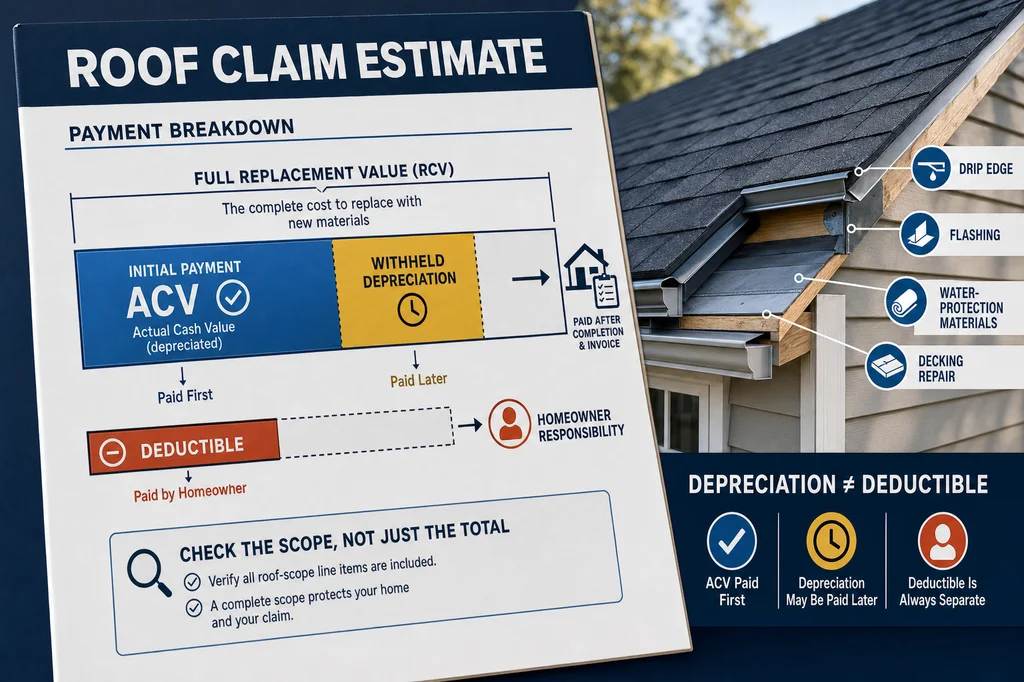
For a roof insurance claim, ACV versus RCV can determine how much you receive upfront and what may be paid after replacement. Before treating an insurer’s first estimate as final, review withheld depreciation, your policy deductible, and whether the scope includes every necessary item for your roof.
Why the first roof-claim check may be smaller than the approved work
An initial payment may reflect actual cash value, not the full replacement cost. That difference is often withheld depreciation, which may be released after completed work and submission of the required invoice or other documentation.
ACV, or actual cash value, is the insurer’s value for the existing roof after depreciation. RCV, or replacement cost value, is the amount described as the cost to replace it with new materials. On a policy with recoverable depreciation, the claim process may involve an ACV payment first and a later payment for the withheld depreciation after the roof is completed.
This distinction matters because a first check is not necessarily a contractor’s complete project budget. A low initial payment can tempt a homeowner to seek a contractor willing to do the entire job for that amount, even though the claim may include an additional recoverable-depreciation payment later.
Read the estimate and policy together. Look for labels such as actual cash value, replacement cost value, depreciation, recoverable depreciation, and non-recoverable depreciation. Non-recoverable depreciation may not be paid later, even after the work is finished. A policy change can also affect whether depreciation is recoverable, so review renewal documents rather than assuming an older form of coverage still applies.
What a roof insurance estimate can leave out
An adjuster’s estimate can miss job-specific items, especially after widespread storm damage when inspections move quickly. A supplement is the process of adding documented items that were absent from the original scope; it is not simply a request for a larger payout.
Insurance estimates are commonly prepared in Xactimate or similar estimating software. The software organizes work into priced line items, but the estimate still depends on the inspection, measurements, local requirements, and the details visible at the time. A qualified roofing professional can compare the proposed scope with the actual work needed and document omissions for the insurer to review.
Potential scope items depend on the property and local requirements, but the claim discussion identified these areas as worth checking:
- Edge and water-management materials: Drip edge, flashing, and water-protection materials may be necessary parts of a proper roof assembly.
- Roof-deck repairs: Damaged decking may not be apparent until the replacement work is underway.
- Code-related work: If local requirements affect the replacement, the estimate may need to address those items. Confirm local requirements with a licensed professional or the local building department.
- Related storm damage: Gutters, siding, windows, and soft metal components can help document the extent of a weather event, when applicable.
The practical goal is simple: compare the insurer’s line-item scope to the work your home actually requires. Do not evaluate an estimate only by its total dollar amount.
When a shingle match does not settle the repair question
A material-identification report can help establish what product is on your roof, but it does not automatically prove that a repair will work. It may identify a shingle’s manufacturer, color, or availability and can inform whether a matching material is still made.
ITEL is a third-party material-identification service that may be used when the insurer and contractor disagree about the existing shingle or siding product. Its finding can be relevant to a repair-versus-replacement decision, particularly if the original material has been discontinued.
Still, a match on paper does not guarantee a sound repair. Roof age, installation methods, and site conditions can affect repairability. If the insurer proposes a repair, ask for the written basis for the material match and have a licensed roofer explain whether the proposed repair can be completed without creating a separate installation problem.
Handle the deductible as a separate homeowner obligation
Your deductible is the portion of a covered loss assigned by your policy, and it is separate from depreciation. The insurer may account for it in the claim calculation rather than collecting it directly from you, but that does not necessarily mean it has already been paid to the contractor.
Do not rely on a verbal promise that a contractor will “cover,” hide, or absorb the deductible. Such arrangements can create problems depending on the contract, policy, and state. Get the payment schedule in writing, compare it with the claim documents, and contact your insurer or state insurance department if you are unsure how deductible handling should work where you live.
Review the scope before signing a roofing contract
The key decision is not finding the lowest bid; it is choosing a contractor whose written scope matches the necessary work and who can clearly explain differences from the insurance estimate. A much lower proposal may omit line items, use a different material plan, or fail to account for claim documentation.
Before signing, ask for one written scope that identifies the roof areas being replaced, included materials, known exclusions, payment schedule, and how newly discovered conditions will be documented. A contractor can attend an adjuster meeting and provide roof-specific documentation, but your insurer decides coverage and payment under the policy.
Use these questions to compare the estimate with the proposed work:
- Which items in the insurer’s estimate are included in your contract, and which are not?
- What depreciation is shown as recoverable, and what documentation is needed before it may be released?
- Are there missing items that you believe should be submitted as a supplement? What evidence supports each one?
- If a repair is proposed, what does the material-identification result establish, and what roof conditions could still affect repairability?
- How will you document the completed work for the final claim submission?
Choosing a contractor who cannot explain the scope can get expensive after work begins. Directorii lists verified contractors.
Keep copies of the policy declarations, insurer estimate, photos, material reports, supplements, invoices, and final completion records. If you dispute coverage, deductible treatment, or policy language, review the policy directly and consider guidance from your insurer, state insurance department, or qualified legal or insurance professional.
Source: Insurance Companies HATE When Homeowners Know This About Roofing Claims
FAQ
What is the difference between ACV and RCV on a roof claim?
ACV is the depreciated value assigned to your existing roof, while RCV is the stated cost to replace it with new materials. Depending on your policy, an insurer may issue an ACV payment first and later release recoverable depreciation after completed work and required documentation are submitted.
Will I receive withheld depreciation after my roof is replaced?
You may receive withheld depreciation after replacement if your policy provides recoverable depreciation and you meet its documentation requirements. If depreciation is non-recoverable, it may not be paid later. Check the estimate and policy language instead of assuming every roof claim includes a second payment.
Should I accept the first insurance estimate for my roof?
You should review the first estimate carefully before accepting it as the complete scope. An estimate can omit roof-specific items such as flashing, drip edge, decking repairs, water-protection materials, or locally required work. A licensed roofer can document conditions and identify items that may warrant a supplement.
Can a contractor waive my roof insurance deductible?
Do not assume a contractor can waive, conceal, or absorb your deductible without consequences. Deductible handling depends on your policy, contract, and state requirements. Compare the claim calculation with the contractor’s payment schedule and seek clarification from your insurer or state insurance department when the arrangement is unclear.
What does an ITEL report tell me about a roof repair?
An ITEL report can identify roofing or siding material characteristics, including possible manufacturer, color, and availability. That information can help evaluate whether a matching product exists. It does not guarantee that a repair is appropriate, because roof age, installation methods, and other conditions can still affect repairability.